MHA’s 2024 Policy Institute: Social Drivers of Mental Health- Panel 3: Economic Security
- October 28, 2025
- 12:34 pm
This panel discussed the connection between mental health and financial insecurity and effective interventions which include direct cash assistance and other financial supports such as the Child Tax Credit. The panel also highlighted the importance of non-discriminatory policies such as not requiring drug testing.
Summary
Panelists discussed economic security, focusing on guaranteed income and tax credits for families, particularly pregnant and parenting individuals. Programs like direct cash assistance demonstrated reduced stress, depression, and homelessness, and improved trust in healthcare. The Child Tax Credit (CTC) and Earned Income Tax Credit (EITC) expansions reduced poverty short-term, but ongoing support is needed. Barriers include work requirements and lack of trust or lived-experience voices in policymaking.
Raw Transcript
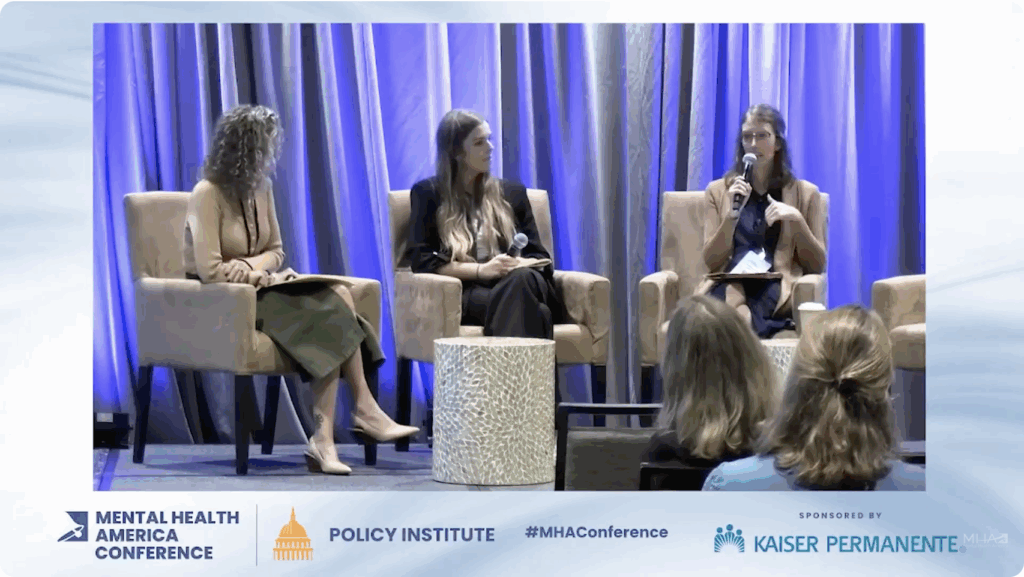
[00:00] We have both panelists identified and our moderators so we will go ahead and introduce the next panel on economic security which will be moderated by Tanya Fullwider from Mental Health America of Ohio where Tanya has had
[00:20] nearly a dozen years experience in addition to her role as executive director. She's co-founder and director for the Paranatal Outreach and Engagement Paranatal Outreach and Encouragement for Moms or POEM program, a nonprofit that merged with MHA Ohio in 2013.
[00:40] and provides maternal supports, including peer support. It is an award-winning program recognized for her contributions to both mental health and child bearing. Tonia works to ensure that each member of MHA Ohio has the necessary tools, skills, and support.
[01:00] to excel in their roles. Beyond her professional endeavors, she is a proud mom of two adult daughters and resides in Columbus. Tanya, please welcome to the stage.
[01:20] No, but we can also invite Tegan and Ana to also join us on stage. We can just give them a minute.
[01:40] Good afternoon. I think what we'll do is actually have Tegan and Ana introduce themselves and tell us about themselves and then we'll get started with questions.
[02:00] My name is Tegan. I'm the director of program operations and implementation at the Bridge Project, which is the first and largest direct cash program for pregnant and parenting people in the United States. And I'm also the managing director of the Maternal Infant Cash Coalition, which is a working group of all of the direct cash programs.
[02:20] for pregnant and parenting folks working to advance policy and research on this specific area.
[02:40] I work on the intersection of income, housing, some Medicaid policy here and there. So I wear a few different hats in this role, and I'm excited to share some of the work today that my colleagues have done on the earned income tax credit and the child tax credit.
[03:00] Wonderful. Thank you. So I'll start us off with a few background data points and then we'll jump into questions. So US Census Bureau data showed that 14% of children, nearly 10 million, experienced poverty in the United States in 2023, a 10%
[03:20] increase from the previous year and a 163% increase from 2021, according to First Focus for Children. In addition to the increase in overall child poverty rates, racial and ethnic disparities in child poverty increased in 2023 with 20% of black children in 20—
[03:40] 22% of Latino children experiencing poverty compared to 7% of white children. The Center for Law and Social Policy's 2023 youth data portrait indicates the young adult poverty rate increased to 15.3% in 2022, the highest since 2017.
[04:00] High socioeconomic deprivation is tied to poor mental health and cognitive performance when controlled for several factors in a study of 10,000 children. Policies that promote economic security, such as guaranteed income or tax credits, can boost
[04:20] social drivers of mental health. Cash payments cannot substitute for care, but do help stabilize households in our protective factor to prevent mental decline. So nearly all MHA affiliates report their organizations focus on adult-
[04:40] and economically disadvantaged. Overall, our affiliate communities look demographically similar to those of the wider US population, including poverty, age, and race and ethnicity. And our affiliates have said financial strain on their clients due to COVID resulted in a decrease in utilization.
[05:00] utilization of services. So framing all that, we'll start with Tegan's question. So there's economic data showing US has a strong economy. Yet, data also show that poverty rates have not declined and individuals cite cost as a major barrier to mental health care.
[05:20] often waiting for a crisis before they get help. While 988 and the Crisis Lifeline have seen historic federal investments, we know crisis is not a win. So can you describe models of guaranteed income programs, including direct cash assistance, that show promise for individuals?
[05:40] and families who may experience mental health conditions and how these pilots and programs are being funded.
[06:00] give people cash without any specific community or you know really requiring that they belong to a specific experience in order to receive that cash. And then there's also targeted programs which is the one that I work for. Some of the different targeted programs will be like for folks leaving incarceration or youth who are
[06:20] are aging out of foster care system. There's different racial and ethnic sort of programs. And then there's also this sub-movement that I'm representing today, which is for people who are pregnant and through the first 1,000 days of an infant's life. So even across the targeted and non-targeted programs, though, there are some really important things that are going to be available.
[06:40] There are a lot of consistencies just in direct cash and guaranteed income models. The heart of it really is the same. We're giving a group of people unrestricted, unconditional cash consistently over a certain period of time. And the piece of this that I really want to emphasize is the unconditional and the unrestricted.
[07:00] This is the key when we talk about outcomes. Unrestricted, meaning it can be used on anything. I'm not telling you what you have to use your money on. I'm not saying you can't use it on this, it has to be on this, or it has to, you know, go towards this. I know. I'm not telling you anything. And then also, on conditional.
[07:20] Meaning you don't have to earn it in any way. Like you don't have to have a job to get this. I don't determine if you are worthy of money. I don't determine if you are unworthy of money. If you meet the eligibility requirements for the program, you are in and you get the money. There's no worthy and unworthy.
[07:40] And so that is really the crux of these programs is giving people cash, no strings attached, no questions asked, that they can use to fill in the gaps and sort of achieve wellness with whatever that means for their specific situation. And then when we talk about funding, there are a couple of different
[08:00] models of funding. One of the most popular models, especially during COVID, was ARPA funds. A lot of cities and counties were receiving funds from the American Rescue Plan that they kind of got to have some flexibility to use for programs they thought were a good idea. And a lot of those actually ended up going to
[08:20] unconditional cash programs. But now ARPA funds are running out, right? And so we have to kind of figure out a way, okay, how do we make this sustainable? And that's where a lot of folks in the movement are looking toward like public funds, looking at private foundations and trying to see how we can, you know, keep programs going past the COVID pandemic.
[08:40] I work for though in particular is completely privately funded. We are all have high net worth individuals that fund our program and are really working on kind of piloting this private-public partnership model. We actually recently just got public funding from the city of New York to
[09:00] do a program specifically for pregnant people experiencing homelessness. We will be launching this year but are really trying to create both like a community and sort of philanthropic buy in by having this partnership model and then also government and public official buy in by kind of working together.
[09:20] together to address these solutions or these issues that affect all of us.
[09:40] these programs have on ED visits, hospitalization, or speaking to any other mental health care or support? Yeah, I mean the outcomes are, we could talk about truly forever. Cash is like the most universal thing in the entire world, and so it affects every single aspect of your life. Like it's not just housing, it's not just food, it's not just medical visits, it's literally everything.
[10:00] I mean, talking about health outcomes in particular though, across the entire movement, we've seen time and time again a decrease in reported depression and anxiety, depression, or reduction, sorry, in hospitalizations and emergency room visits and an increase in preventative healthcare appointments, which then means
[10:20] Folks are nipping problems in the bud when they are cheaper and easier to solve and not waiting until it becomes a crisis or this large problem to then seek treatment. We are also seeing an increase in sort of trust and buy-in in healthcare systems, which is really important. So many people who wait until they have a crisis to go to
[10:40] the emergency room, do so A, because of cost and access, but then also B, because they might not trust these institutions to address their specific situation or to do so in a kind of bias-free or community kind of responsive way. And we're seeing that this is actually, as folks have more
[11:00] Sort of facetime with their health care providers. They're seeing oh wait I can actually trust this person and I can actually go more often. They have my best interest in mind And this is driving trust in health care institutions, which is a really exciting outcome to me More specifically though when we look at the programs for pregnant and parenting people This is the the subgroup that I am most knowledgeable
[11:20] knowledgeable about. I mean, 98% of our moms in our program in particular, and actually I'll start this by saying, we have 1,400 moms in our program right now. We are running an RCT with the University of Pennsylvania and the Columbia University. It's the largest RCT happening on direct cash for pregnant and parenting people.
[11:40] Our program is three years long and so we have initial data. We've run our program currently for 2.5 years but we haven't reached the full three. So I can't tell you what happens after three but I can tell you what happens after 2.5. 98% of our moms reported a decrease in stress during pregnancy which is huge when we talk about
[12:00] hormonal regulation, the way that hormones affect the fetus. We also saw a 25% reduction in post-parum depression, which is massive, right? And super important, especially as we're thinking about not only mom's outcomes, but also baby's outcomes. We also have seen more brain activity sooner in the baby's life.
[12:20] babies whose families were receiving this unrestricted cash, which is really interesting and also associated with not only longer term outcomes just in general, lifetime earnings, you know, high school graduation rates, college acceptance rates, all these different things, but also their mental health throughout the course of their life, right? More activity, brain activity, sooner at the beginning of your life is a really
[12:40] good thing. And we're seeing that cash infusions can drive that. We have talked a lot about homelessness today. We also have seen that I would say like 25, it's like 25.4% of our moms are experiencing homelessness, varying kinds of homelessness, right? There's like sheltered inencampments, going between family and friendhouses, all these different things.
[13:00] 63% of moms in our program after one year who were experiencing homelessness had stable housing. 63% is huge and a very exciting finding. To that point, we've had many moms who were unable to have a specific data point because of the nature of it.
[13:20] domestic violence is a little harder to study. But we've had quite a few moms who have reported being able to leave their abuser or leaving an abusive situation because for the first time in their lives they have money that they has their name on it that they are in control of and they get to decide how to spend, which is huge and super exciting, right? Especially if you're
[13:40] pregnant, the number one cause of death for pregnant people is their male partner. And so being able to infuse cash at that time and say you can choose what this is used for and being able to use that to leave an abusive situation is an incredible outcome. So we are seeing a lot of really exciting outcomes both in the movement.
[14:00] cash as a whole, but then also specifically within the movement for pregnant and parenting people as well. Wow. Just take a breath there. Wow. So tell us a little bit more about the members and stakeholders that you work with in the coalition and then
[14:20] And just kind of anything else around the ultimate goal. Yeah, so like I mentioned, we have the Mother and Infant Cash Coalition. Right now there are 14 programs across the United States that are direct cash programs beginning in pregnancy and going through infancy at some point. Some are 18 months, some are 30 months.
[14:40] years, they end at different points, but everyone is starting in pregnancy and through at least that first year postpartum. And so the 14 programs, the program administrators are part of this coalition. But then we also have policy institutions and research institutions who are really committed to the idea of advancing this issue and also funders who are very
[15:00] interested in kind of seeing this idea take off and be adopted by public agencies at a state or federal level. So the ultimate goal of the coalition is to institute a federal direct cash program that begins in pregnancy and goes through infancy. We've seen a lot of very similar or I guess yeah
[15:20] similar topics of conversation happening from both parties lately around child tax credits and baby bonuses and sort of, you know, infusing unrestricted cash in those initial years. And we're working with folks right now to encourage that those programs start during pregnancy because that is really where the cash is most effective, right, is when we start in pregnancy. But we also
[15:40] are doing a lot of research to really understand sort of different angles that haven't been studied yet. One of the questions we're looking at that I'm most excited about is the way that cash does or does not increase trust in government institutions, increase participation in maybe voting systems or in
[16:00] in community and community level buy-in and the way that people feel that they belong in their community and are able to participate. I think there's obviously health outcomes, there are housing and education, all these different outcomes, but we're really also trying to push that a level higher and say, what are the community level outcomes that we can see coming from that and how can we
[16:20] create the communities that we want to see through this relatively simple program that we know how to implement. So that is the coalition. That is what we're working on. Pretty lofty goals, but give us seven to ten years and... Amazing, amazing. Thank you.
[16:40] ask you a few questions. So financial strain due to COVID-19 public health emergency made it difficult for individuals and families to make ends meet. However the American Rescue Plan Act expanded two key tax credits that help children and working families. Can you describe the child
[17:00] tax credit or CTC and the earned income tax credit, EITC, to those who may not have heard of these before. A little more. Sure. I will give it my best. So first off, when we start to talk about tax codes, some people kind of shrink and are
[17:20] are like, oh no, I'm a turtle, I don't want to talk about taxes. But this is good policy. This is interesting tax policy. So first off, what is a tax credit? A tax credit simply reduces the tax that you owe, meaning you get to keep more money in your pocket because you don't have to pay.
[17:40] back to the federal government. We have tax credits, we have partially refundable tax credits and we have fully refundable tax credits. A tax credit is refundable if part or all of, so if the tax credit itself is more than the amount of taxes that you owe,
[18:00] you still get to pocket the difference. You get to keep that, you actually get a reimbursement from the government. So it is a kind of cash transfer. All right, so that's some basics on tax credits. Both the earned income tax credit and the child tax credit are targeted tax credits.
[18:20] credits, meaning that it's based on your income that year. And I'm going to get to what happened during the American Rescue Plan Act expansion, but I'm going to start by generally talking about how these tax credits usually work and how they're working today.
[18:40] So folks have to file income taxes in April, right? That is when people get the tax credit. They get it on a yearly basis usually. So child tax credit. Let's start with that one. Child tax credit is for families with kids under 17. So once they turn 17, the family is going to get their tax credit.
[19:00] is no longer eligible. It maxes out usually around $2,000 per kiddo and it is partially refundable. That means it's not fully refundable. That leaves a lot of the lowest income families to not get any of
[19:20] the tax credit or only get some of it. So it's important thing to understand about sort of a way that the current child tax credit doesn't always serve people with the lowest incomes. And yeah, so that's generally how the child tax credit works. During the pandemic,
[19:40] During the American Rescue Plan Act in 2021, the child tax credit was expanded so that it provided more money to families, $3,000 per child instead of two, and for kids under six, $3,600 per child. It also allowed families to get about half of the credit.
[20:00] upfront on a monthly basis instead of having to wait all the way until the end of the year or the beginning of the next year to file. So that allows families to meet their most immediate needs. Getting a yearly refund can absolutely be really helpful because folks can pay off debt that they might have accumulated.
[20:20] They can get caught up on rent if they're behind or invest in things that they haven't been able to save for that their family really needs. So another thing that the ctc expansion through the american rescue plan acted was it made the child tax credit fully.
[20:40] refundable. That meant that even families with the lowest incomes or even no incomes got the full amount. So that was a huge deal. But it was just one year. It expired. It didn't get extended. So we've kind of pulled those improvements out from underneath families. So let's talk now.
[21:00] about the earned income tax credit. Similar in some ways, but this is for for workers and it works differently for families with kids compared to families without kids. So family it's it's another program that is based on income and so it kind of phases in as your incomes goes up, plateaus and then
[21:20] goes back down, it phases out as your income goes up. For families with kids, it can be a really substantial amount of money. It can be nearly $4,000 a year. But if you don't have kids or you're a non-custodial parent, meaning the kid doesn't live with you in your home.
[21:40] You qualify for a much, much smaller tax credit. It is often just a couple hundred dollars for folks. The other quirk about the Earned Income Tax Credit is that young folks and older folks who are working don't qualify. So if you're 24 or under or you're 24.
[22:00] 65 and over, even though you're working, you don't qualify for their end income tax credit. So again, during the American Rescue Plan Act in 2021, a lot of those sort of shortcomings were resolved. The tax credit was expanded to young and older adults.
[22:20] It was increased substantially for folks who don't have kids or non-custodial parent. And together these tax credits made a really huge impact on reducing poverty. We saw millions of kids, about 4 million kids, lifted out of poverty altogether. A lot of folks experiencing deep poverty.
[22:40] there is help to mitigate their poverty. So that's kind of where we stand right now, but really really quickly and we can talk about this more later, I want to remind folks that states can also have their own earned income tax credit and child tax credit.
[23:00] credit and there are a lot of states that do. Thank you. Very helpful. Very helpful. And you've shared a little here but ask you to expand on. So the impact that these tax credits have had on families to afford necessities like.
[23:20] nutrition, housing, improving connections to mental health services, especially children. And then considering that the child tax credit has been discussed by both major party presidential campaigns, can you discuss the various options being considered by federal and state governments to expand these things?
[23:40] credits. Sure. So I'm gonna take those in two chunks. This is a lot. So in terms of the impact that these credits have on families, it's honestly a huge overlap with what Tegan was describing in terms of the outcomes that we see for folks. But one
[24:00] important thing I want to mention is because of the racial disparities that Tonya mentioned earlier, that these tax credits help to advance racial equity by helping to close those gaps to some degree. Not close them, but narrow them. They certainly don't close them. So it's not enough. We need to do better.
[24:20] but they do help to advance racial equity. And we know from research about how families spend the funds that they get from tax credits that these are helping families meet their most basic needs like covering rent costs, like paying for food, like buying school supplies.
[24:40] those sorts of things. So it's just a reminder that we can trust families to make decisions for themselves about how they need to spend their funds. We don't we don't need to tell them how to do that. That folks are struggling to make ends meet. They're no fault of their own, but because of the systems that are designed
[25:00] in ways that make it difficult for people to do that. In terms of some of the additional research we've seen, so during the child tax credit expansion, researchers were like, oh this is a natural experiment, we should study this. And there are some, there's one particular
[25:20] study that found that for adults the child tax credit contributed to a reduction in depressive symptoms, a depression, a reduction in anxiety symptoms. Another study found reduction in anxiety symptoms. And then there I want to be honest there was one
[25:40] study that was inconclusive and the authors of that study said you know that may be because this was temporary, that families didn't know if they could count on this because it was just for one year. So it'd be really interesting if the child tax credit were expanded on a permanent basis to
[26:00] to learn more about those outcomes. But I'm not gonna belabor the outcomes piece because Tagan really covered it. We kind of know that it improves people's wellbeing. But you asked me a question about opportunities, like proposals that are out there. Yes, yes, various options being considered. And I know you mean it.
[26:20] I mentioned states, so federal state governments to expand potentially just opportunities. Okay, so at the center where I work, we would really like to at least get back to the expansion under the American Rescue Plan Act for both the Earned Income Tax Credit and the Child Tax Credit.
[26:40] Recently, there was a bipartisan deal that came together in Congress, but didn't quite make it across the finish line. So that wouldn't have got us all the way back to the 2020-2021 level for the child tax credit, but it would have helped boost income.
[27:00] income for families at the lowest income levels. It would have been a step in that direction. It got caught up in some pre-election politics and didn't pass, but it just is an example of how there's some bipartisan energy around these ideas, especially around the child tax credit.
[27:20] You have heard that the presidential candidates have, that child tax credits or tax credits have come up in those conversations. We've seen from the Harris-Wolce campaign, a clear articulation of a platform, on their platform of wanting to see that robust expansion of the country.
[27:40] the child tax credit and actually building further than what we had in 2021. So in addition to having the expansion, they want to add a $6,000 tax credit for kids in that first year of life, which as Teigen has talked about is a really crucial point in development and for families.
[28:00] and the costs that families are incurring during that time. On the Trump advance side, there have been some signals that there might be interest, but there's not clarity on sort of where exactly the campaign lands, but there have been a few statements made.
[28:20] In the last few weeks that signaled there might be some interest there, but like I said, I can't really speak to the details because they haven't been published. And states. States. So I think there's about 30 states that have a
[28:40] earned income tax credit and like 14 ish like a little over a dozen states that have a child tax credit and we've seen a number of states take steps in recent state legislative sessions to create new programs, expanding existing programs, make existing programs fully refundable.
[29:00] And we even saw one state, I think it was Minnesota. Thanks. I'm from Minnesota, so yeah. Minnesota adopted a provision to make that one of their tax credits monthly or, you know, less than, more for
[29:20] frequent than annual. Feel free to chime in if you know the details. I know, I mean, yes, monthly. In Minnesota, the refund is monthly, which is similar and modeled off the expanded child tax credit that we saw in 2021 and is functionally a guaranteed income program, though packaged in a more palatable way as a tax credit.
[29:40] She said it, I didn't. So I think the last thing I would say on this point is next year, 2025 is going to be a big tax policy year in the hill because there are expiring tax provisions from the 2017 tax law. And so there's going to be a tax package.
[30:00] that's a huge opportunity coming up real fast to try to make sure that people with the lowest incomes are front and center on whatever policies are put together there. That the people who need that boost in income most are prioritized. Thank you.
[30:20] I know there's a lot of parts. Thank you very, very much. So we've talked with both before and today about the importance of self-determination, trust, and choice as factors for policymakers to consider when determining support for income assistance and other policies that lift people out of poverty.
[30:40] So can you discuss some of the barriers that people face and that may help grow understanding of the decisions people have to make when living with a chronic mental health issue? Yeah, so I can kick it off and you should totally jump in. I forgot to mention that I started out my career
[31:00] when I was a brand new social worker working in community mental health. So in answering this question, I'm really reflecting back on my experience as a case manager. Any other current or former case managers in the room? Yeah. Y'all know what I'm going to talk about. So first off, I would say, right, kind of regardless of whether or not you have a.
[31:20] chronic mental health condition. If your income is really low and you don't have, like having a hard time making ends meet, you're always having to make trade-offs between your most basic needs and your mental health and wellbeing is among those most basic needs. We have 24 million people living in.
[31:40] You're paying half or more of their income in rent. You can't pay that much on your rent and not also struggle to Pay for your medications, pay for food, for basic, basic needs. And then if you add
[32:00] So somebody who has a chronic mental health condition can sort of exacerbate or compound those kinds of existing challenges that folks are facing. For example, I think about someone who is having to make that call of like, gosh, I really don't want to end up in the street.
[32:20] So I'm gonna put all my money into rent and now I don't have enough money to pay for my copay And now I'm suddenly off of my medications and my symptoms are going up And it's showing up in the way I am going to work and it can just lead to a spiral effect
[32:40] for somebody who is otherwise doing well and engaged in services. I can also think about folks who maybe need to take a sick day to take care of their mental health or their kids mental health but they don't have paid leave. So by taking
[33:00] time off, they risk their employment altogether and at very least have a smaller paycheck that month and so that exacerbates those sort of tensions that people are facing all the time of like how am I going to stay housed, how am I going to stay fed.
[33:20] those are some that I can't I can't encapsulate everybody's experiences but those are some of the things that come to mind about what people are struggling with and I just I mean you've talked about this already but like people know their own circumstances best and so empowering them
[33:40] them to use their money in the way that best meets their needs is smart. And it gives people dignity and respect. I'll also just add that trust is really important because of the way that it makes people feel, obviously, in their experience. That is first and foremost. And trust-based policy is also just really
[34:00] effective and we have a lot of data that says that right the number one question that I always get is like well what if people spend it on drugs and alcohol well what if people spend it on gambling right if I mean if I had a dollar for every time someone asked me that like we could end child poverty for ones and for all but there's so much research on this and the fact of the matter is they
[34:20] don't. They don't. And we have so many studies that tells us that when we give people unrestricted cash they spend it on things that they and their family needs to achieve wellness, to achieve stability. They spend it well. My team is made up of a bunch of Wharton business people and so we are not
[34:40] interested in just spending money for spending money's sake that is not not something we're down for. We want effective policy and we want cost efficient policy and with the expanded child tax credit for example there was a 10 to 1 ROI right so for every $1 that was spent on the expanded child tax credit $10 were generated for the economy.
[35:00] So not only is trust very important because of people's experience, because of how it makes people feel, it's also just really good for the economy. And that, you know, if you're not moved by trusting people because it makes them feel good, maybe you are moved by the fact that it's a good economic policy.
[35:20] Yes. All right. So I have to connect to peer support and community mental health in a question. So of course we have a program that Karen mentioned, a peer support program in Ohio. Baltimore, Maryland runs a peer navigator program out of its library.
[35:40] and has piloted peer specialists in an unemployment office to help provide connection and relationship to individuals experiencing emotional distress. How do you, and this is to both of you, how do you think policymakers can support collaboration and partnership between government agencies and community mental health organizations?
[36:00] organizations to more holistically meet the social and mental health needs of individuals and families. Do you want to go first? I can. Okay, go for it. So I want to circle back to the values point that you mentioned earlier. I think that the values.
[36:20] that are embodied in peer support about meeting people where they're at, about coming with a non-judgmental stance, and that people who are sort of closest to the problem are closest to the solutions.
[36:40] I keep listing the really important values. I think they're really aligned with the kinds of programs that we're talking about. But the other thing I think about is just the practical barriers to accessing whatever resources if it's a tax credit, if it's figuring out how to get signed up for a guaranteed income program.
[37:00] program, that those are really rich resources and peers can be an ally in figuring out, okay, how do I get connected to that? How do I know about what's available to me in my community? And so how do I file for taxes? I haven't filed for taxes in the last couple of years because I didn't think I really
[37:20] made enough money for it to matter, but it turns out I have some resources at my disposal. So I think peers can be a really important connective tissue. And to the trust point that you've made too, we're talking about people who've been really let down.
[37:40] and harmed often by the systems that are supposed to be there to take care of them, but always aren't really designed or functioning in that way. And so to have somebody who has had this experience before say, I know how to make this work for
[38:00] you and the way that causes you the least harm I think is a really important step. So that's kind of what comes to mind for me. I'll say for policymakers in particular, during the bill writing process, I really, really encourage you to get folks on the ground and with lived experience in the room when you're writing that bill.
[38:20] Speaking from personal experience, it might not always be so intuitive to say I'm writing this bill, let me figure out how I can contact a case worker at a local shelter or how I can talk to a social worker in X, Y, and Z place. But folks on the ground who are dealing with this every single day have understanding of nuances that
[38:40] We just could never know unless you're there doing it, right? And when you are the person writing the bill or sort of leading that campaign, you get to decide who's in the room, you get to decide who's at the table. So I would really just say make space for the people that are on the ground doing the work and for people with lived experience too and then take their insight and their advice seriously.
[39:00] Seriously. Here, here. All right, final question, also to both of you. So what do you see as the next steps for policymakers to build from where we are to promote economic security and mental health?
[39:20] Okay, well, I will just say, in terms of next steps, we really need people to be bold and we need people to be stud fast in their boldness. This expanded child tax credit, for example, that was considered a pretty controversial idea to give unrestricted cash payments regularly during COVID, right? And it only happened because...
[39:40] because some policy advisors in D.C. were like, hey, the evidence says this thing. We don't know how people are gonna react. They might not like it, but the evidence says this, so we're gonna do it. And we cut child poverty in half. We need people who are gonna come to the table, follow the evidence, and not get caught up in what people might say or if it's controversial or if, you know.
[40:00] All these different things. If the evidence is suggesting something, we need to let the evidence lead. But I will also say we need people to be steadfast in that support, and that's for policymakers, funders, advocates. Something we're seeing across the cash movement right now is that eight states currently have banned guaranteed income programs in their states.
[40:20] And so there's a wave of banning these programs, right? And it's coming from this place of deep misinformation that this is making people lazy and it's anti-American because whatever, people aren't pulling themselves up by their bootstraps or whatever. That is an issue.
[40:40] We also have seen a lot of different lawsuits too against programs since the repeal of affirmative action. There are some cash programs in particular for black women in the Bay Area who are being sued because they are racist for only accepting black women in their program. These lawsuits or these over-banning and different
[41:00] States. It makes people doubt, right? It makes people get shaky and pull out funding or pull out support because all of a sudden there's this issue, there's this barrier, people aren't sure, and now we don't want to commit, we don't want to cosign this thing. But we have to be steadfast in that, right? Like, hearing both of those examples, they're wrong.
[41:20] you're wrong, to say that we can't have this program specifically targeting maternal health outcomes in the Black community. That is so important. And we need people to cosign those programs and to stand by them even when people have an issue with it and even when people try to shut those programs down.
[41:40] Think I already talked about the the 2017 tax law coming up next year and the role of states here So I'm going to leave it at that. So you have time for Q&A Great, thank you. So yes, I think we have a few minutes for Q&A
[42:00] I think we started five minutes late, so we can go five minutes over, and there's 10 minutes for Q and A for anyone, and we'll start with Ms. Madison Scott. Hi, yes, I work at the Policy Center for Maternal Mental Health, but I also serve as a board member at the MHA Georgia Chapter.
[42:20] And in Georgia this past few years we've had some significant changes in our TANF policies, so our Temporary Assistance for Needy Families. Most specifically, we changed the law so that pregnant people could have access to TANF dollars, but those 20 hours of work requirements remained the same, as well as the income limits. How do
[42:40] we move forward and approach when these policies that are like seemingly supportive are pointless transparently in the state and how do we create barrier or more accessible cash assistance in states that maybe don't see the value in kind of unrestricted that funding.
[43:00] This is a great question. I was going to say don't get me started on work requirements, but I'm started, so we're going to talk about it. Work requirements don't work. Just to be so clear with everybody in this room, there's so much evidence that work requirements, as a part of these programs, it actually just pushes out the
[43:20] people who need this funding the most so that they aren't able to access these the income supports. A lot of our moms in the programs for example they are not able to work 20 hours a week to receive whatever funding programs it is because they're providing childcare all day for their newborn right and the way that we're talking about work is not
[43:40] Like the care work or the labor that women often provide, that's not how we're defining work, right? We're talking about work in this sort of 9 to 5 kind of formal work way. I think, honestly, how I approach those situations, because we run into them all the time too, is just to, number one, come to the table with all of these.
[44:00] evidence that we have so many studies that say that work requirements don't work, they're harmful, and they are the reason why we haven't seen a reduction in poverty since you mentioned in 1996 we passed the bill that created TANF, right? That is why is work requirements. And then if people
[44:20] want to move forward with those work requirements, okay. I came to the table with the evidence, but also, I always just like to make it explicit to everyone in the room that we are moving contrary to the evidence. We can move forward with the work requirements. You clearly want to work and are not going to compromise on that, but just to be clear, this is not an evidence.
[44:40] based policy. And typically, people really don't want to co-sign policy that is not evidence based. And that can encourage people to have more conversations, actually look into the research that you're presenting. You know, if people choose to not take research seriously, that is, I don't know, then you're kind of at a
[45:00] You hit a wall there, right? But I think the best thing that you can do is come to the table with as much evidence as possible and just make it clear that if we want to have evidence-based policy, this is what it looks like. And I'll just add, making it really explicit, that a lot of those restrictive policies, and I know you know this, a lot of those restrictive policies...
[45:20] policies in the TANF program and similar programs are racist. They have racist underpinnings and are like, they're racist. So let's say that. I think I'm not a TANF expert, so I'll say that. I think there are useful levers.
[45:40] within the TANF program that we can pull to try to get as much cash to families as possible while also pursuing other means of getting income into folks pockets. Thank you so much. Shannon Mulvihill, CEO of Mentos.
[46:00] Health Minnesota. And my question is about the bridge project and what the amount is that you're giving to providing to mothers and families and how you determine what the amount is that's going to make a measurable impact for this type of program. Yeah well first of all shout out Minnesota. So glad you're here.
[46:20] So our program is three years, like I mentioned. We start with what we call a prenatal stipend of $1,500 and that is in the third trimester of pregnancy. Really the intention there is for those high dollar baby goods, stroller, crib, all the things you need to prepare for a baby. For the first
[46:40] 15 months of the program, folks receive $1,000 a month. And then for the subsequent 21 months of the program, it steps down to $500 a month. So in total, it ends up being, OK, well, my math is going to be challenged now. But it ends up being, I don't know, somewhere around like, OK, I'm not going to do that math. But.
[47:00] It ends up being a significant amount of money. But we really concentrate the majority of the investment in pregnancy and the first year because we know that that is when interventions are the most effective and have the highest return on investment when they are in that first year period.
[47:20] Hi, are you guys going to speak really loud? No we cannot. We gotta all just talk really loudly.
[47:40] Oh, it's really simple. Turn it on. So I am here on behalf of the DBSA, Depression Bipolar Support Alliance. I also do a lot of work within equitably using individual's lived experience in a variety.
[48:00] of different ways. So I have kind of two questions. The first is we talk, you talked a lot about peer support and I'm wondering if you could expand a little bit on your definition of peer support because we talk a lot about patient navigation and peer support and so DBSA does a lot of work.
[48:20] work in peer to peer support. And I think that that often looks different than patient navigation. And those are different skill sets. And so how we're training people and how we're funding those things is really important and how we're putting those things into policy is really important. So that's question number one. Question number two.
[48:40] is also I'm really interested in hearing your thoughts on how we're engaging people with lived experience equitably. We talk a lot about the importance of it. I hear it all the time, oh, it's important to use people with lived experience. We don't talk a lot about how we're compensating people.
[49:00] when we do talk about how we're compensating them, we hear a lot of, well, it's difficult, you know, if we give them too much money depending on their situation. So there's all these excuses. And so I am interested in your opinion on that, on how to kind of
[49:20] about that so that that isn't an excuse that we use, but also put into place ways that we can really begin to think about how do we use people with lived expertise, they're consultants, they're people that have expertise.
[49:40] in a way that doesn't hurt them financially. Do you want to take the care question? I can start. Sure. I'm just the moderator, but I'll take the question. Well, I'll answer this a couple ways from our experience in Ohio.
[50:00] On the first question, I think you're right. Peers, I mean, one of our partners at the state level says, we have a peer for that, right? What's the situation? We have a peer for that. But I think the way that we, at least what we're working on in Ohio, to
[50:20] make sure that we're properly resourcing and training peers for all the different places that they can and should be is we're piloting an internship program right now in in Columbus so just in one one county in Ohio but you know if you're a
[50:40] social worker, if you're a counselor, if you're a, you know, what, there are internships in practicum and clinicals and peers need to have that too. They need to be able to know what all the different ways that they can engage and then have an opportunity to experience that while getting paid. So we're, we're piloting that now.
[51:00] now, an internship program. So would love to let you know more about how that goes as we're working through that. The second part of the question, then I'll turn it to you all, around when we talk about support and encouraging people with
[51:20] expertise to come to the table. When we're thinking about employers, and I know there's a lot of conversation around workplace wellness and healthy workplaces here, is to ensure that we're creating healthy workplaces for peers.
[51:40] that we have functioning employers that we're adhering to practices that mean that we're lifting up peers in their experiences in creating a healthy workplace. And I know I need to wrap it up, so I let you all have the last word there.
[52:00] do you want to? Go for it. Okay. So in terms of paying people for their time and making sure that people with lived expertise and or lived experience are engaged, I feel like the organization where I work at we're on sort of early ish in our journey.
[52:20] there. Because we've I think there's been a lot of anxiety about tokenizing people as a policy institution and the recognition that what we need is relationship-building, we've sort of like treaded a little bit lightly. On compensation I will say
[52:40] One thing that I've heard work and seen work is is Explaining to people their options we could pay you this way and this way and this way and here's how it may or may Not impact your access to public benefits for example and letting people choose The payment method that works best for them and that reflects their time
[53:00] I'm a part of some projects around homelessness that are paying consultants with lived experience, an hourly rate that is comparable to what other professional consultants that we pay. So that's just a couple of examples.
[53:20] But I will say in the policy space, we're trying to figure out how to do it in a way that's not tokenizing and retraumatizing people. But I think part of it is moving beyond gathering information from people and towards sharing decision-making power. And that's the scary part, right? And that's addressing white dominance.
[53:40] culture stuff that like all of our organizations should be on never-ending journeys about. So that's a whole other topic but that's that's what comes up for me. I think we got to wrap it up. We have a really excited young person who's going to receive an award. So thank you so much.
[54:00] much, Tonya, Tegan, and Ana.