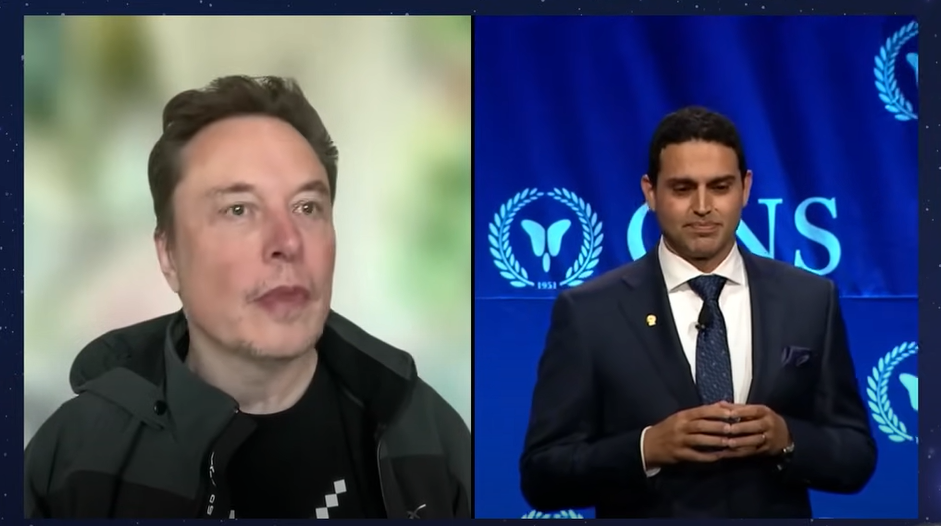
CNS 2024 – Michael L.J, Apuzzo Lecture on Creativity & Innovation: Elon Musk & Dr. A. Khalessi
- October 9, 2025
- 11:02 am
Summary
Neuralink at the CNS Apuzzo Lecture: Creativity, Innovation, and the Road to High-Bandwidth Brain Interfaces
Edited from a fireside conversation with Elon Musk at the 2024 CNS Michael L. J. Apuzzo Lecture on Creativity and Innovation.
Table of Contents
- Overview
- Founder’s Motivation
- The Bottleneck: Human–Machine Bandwidth
- Why an Implant? Technical Approach
- Early Human Results
- Scaling the System: More Electrodes, Less Latency
- The Surgical Robot and Workforce Reality
- Key Engineering Challenges
- Clinical Horizons
- Upgrades, Reversibility, and Cost
- On Difficulty: Brain Surgery vs. Rocket Science
- Conclusion
- Key Takeaways
Overview
The CNS Apuzzo Lecture honored a career defined by scientific rigor and creative daring. In that spirit, Elon Musk outlined Neuralink’s progress and vision: high-bandwidth brain–computer interfaces (BCIs) that begin by restoring function for people with paralysis and blindness, and ultimately explore whole-brain communication between humans and machines.
Founder’s Motivation
Musk’s starting point is unusual: mitigating the risk of unaligned digital superintelligence. His thesis is that tighter, higher-bandwidth coupling between humans and their “digital tertiary self” (our phones, apps, and cloud tools) could keep AI aligned with collective human intent.
The Bottleneck: Human–Machine Bandwidth
We already live as “cyborgs,” but our output bandwidth is painfully slow—often <1 bit/second on average over a day. Speech and thumb-typing are low-symbol-rate channels trying to steer supercomputer-class devices. Solving bandwidth—particularly brain→device output—is the core BCI opportunity.
Why an Implant? Technical Approach
To reach million-bit/second territory, noninvasive methods won’t suffice today. Neuralink’s approach:
- Fully implanted device replacing a coin-sized piece of skull.
- Ultra-fine flexible threads (“electrodes”) inserted into cortex by a surgical robot for micron-scale precision despite brain motion from pulse and respiration.
- Onboard electronics to sense, process, and wirelessly transmit neural signals; charging is transcutaneous.
Early Human Results
The first clinical focus, “Telepathy,” reads motor cortex signals to control a cursor by thought:
- ~1,000 electrodes per device; initial effective yield ~10% in the first patient (≈100 channels).
- Throughput: ~10 bits/second already—world-leading in this class—and sufficient for meaningful computer control (including video games played all night by a participant).
- Decoder adaptation can recover function even when some leads retract.
Scaling the System: More Electrodes, Less Latency
Next-gen targets:
- 3,000 electrodes with higher effective yield (e.g., ~1,500 active).
- Lower latency so actions occur essentially at the speed of thought—no “moving the meat puppet” (muscles) required.
- Musk expects BCI users to outperform hand controllers in games within a couple of years.
For a whole-brain interface, the order of magnitude might be ~1 million electrodes, each sampling activity from many nearby neurons.
The Surgical Robot and Workforce Reality
Threads are too small for manual placement, and the brain constantly moves. The R1 robot inserts threads with sub-millimeter accuracy and tracks tissue motion in real time. Beyond precision, robotics addresses scale: there are ~3,000 U.S. neurosurgeons; tens of millions of potential implants will require automated, ophthalmology-style surgical throughput.
Key Engineering Challenges
The body is a hostile, saline environment; the device must be:
- Biostable and hermetic, yet sensitive enough to record micro-volt neural signals.
- Built with advanced materials (e.g., silicon carbide coatings) applied with uniform thickness on ultra-fine threads.
- Power-efficient for high-rate wireless telemetry without frequent recharging.
Clinical Horizons
Near-term therapeutic goals include:
- Paralysis: decode motor intent and control cursors, text entry, and robotic devices; long-term, re-animate one’s own limbs by bypassing spinal lesions (signal “bridging”).
- Blindness: visual cortex stimulation (Neuralink recently received Breakthrough Device designation for “Blindsight”).
- Epilepsy: detect and interrupt electrical storms.
- Neuropsychiatric / neurodevelopmental conditions: as mapping improves, targeted read/write could modulate dysfunctional circuits.
- Neurodegeneration: augment communication (e.g., unlocking the output of minds like Stephen Hawking’s with far higher bandwidth).
Upgrades, Reversibility, and Cost
- Devices are designed to be replaced with minimal tissue disruption; animal studies show multiple successful explants/re-implants.
- Aim for “600-second surgery”: a largely automated, ~10-minute outpatient procedure, Lasik-style.
- Target costs in volume similar to Lasik: eventually a few thousand dollars for device + robot-performed procedure.
On Difficulty: Brain Surgery vs. Rocket Science
Asked to compare, Musk’s verdict: both are extremely hard—and idioms exist for a reason. The frontier is pushing precision, reliability, and scale simultaneously.
Conclusion
Neuralink positions BCI as both a near-term medical tool and a long-term societal lever for human-AI symbiosis. For neurosurgeons, the promise is a new class of precision tools—robot-enabled, high-density, read/write neural interfaces—to restore function, treat circuit-level disease, and expand human capability.
Key Takeaways
- Problem: Human output bandwidth to machines is the choke point (<1 bit/s avg).
- Approach: Fully implanted, high-channel BCIs placed by a surgical robot to achieve precision and scale.
- Status: First patients reach ~10 bps; next gen aims for >1,000 bps and lower latency.
- Clinical Path: Paralysis (cursor control → limb reanimation), blindness (visual cortex), epilepsy (seizure interruption), and circuit-level psychiatric/neurologic targets.
- Scale & Cost: Lasik-like, ~10-minute automated surgery; long-term few-thousand-dollar all-in target.
- Vision: From restorative care to whole-brain interfaces that could align humans and AI through higher-bandwidth symbiosis.
Raw Transcript
[00:00] Congratulations.
[00:20] has become synonymous with creativity itself. His visionary spirit permeated his 19-year tenure as the editor-in-chief of neurosurgery, where Dr. Appuzzo elevated the journal to a new level, imbuing the journal's impeccable scientific rigor with the spirit of artistic genius.
[00:40] spirit of Dr. Apuzzo's creative and innovative drive that this lecture was established. This evening I have the immense pleasure of introducing one of our century's great innovators, Elon Musk. It is for this reason that we welcome him as the 2024 CNS Michael L.J. Apuzzo
[01:00] Pezzo lecturer on creativity and innovation. I can think of no better voice to share his vision for Neuralink. Please join me in welcoming the 2024 CNS Michael L. J. Pezzo lecturer, Elon Musk. APPLAUSE
[01:20] And there he is, Elon, great to see you. Hi. Hello. Well, Elon, you're with the Congress of Neurosurgeons, and as I was just sharing with the group, I really enjoyed.
[01:40] our time together recently. And I thought for those who had not had an opportunity to work and be exposed to Neuralink's technology, you could just share a little bit about your founder's story and what made you interested in bringing computer interface in the first place. Sure.
[02:00] somewhat esoteric and maybe a bit strange, but I was actually trying to figure out how to mitigate the risk of digital superintelligence. And to the degree that we can improve our band
[02:20] with to our digital tertiary self, I think we can better align artificial intelligence with a collective human will. Like I said, this is going to sound very strange. So you can think of basically
[02:40] intelligence is being divided into roughly three areas. There's sort of like a limbic system, like the sort of instinctual elements, sort of like the cortex and the planning part. But then we also have a tertiary layer, which is all the computers that are in the lab are
[03:00] and phones, applications, software that we use. So that you have a digital tertiary cell. Basically we're already an Android, effectively. And in fact, I think people feel this when they forget their phone. Begetting your phone, leaving your phone behind is like having missing limb syndrome.
[03:20] Like you're missing part of your digital tertiary element. The constraint on human machine symbiosis is, however, is bandwidth. What is the, especially, output bandwidth? The output bandwidth
[03:40] of a human is less than one bit per second over the course of a day. So if you have 86,400 seconds in a day, the number of output bits that you produce, I mean, maybe there's some rare cases where it's above one bit per second, but very few people produce 86,400 output bits of, you know,
[04:00] That's a rare situation. So most people are averaging less than 1 per second over a 24-hour period. And when we do speak, the number of symbols per second of speech or typing is quite low, especially if it's going through a phone.
[04:20] You just sort of have two slow-moving meat sticks that are trying to type letters on a phone. So you really have just a few taps per second of character. So your phone is like sitting there and your phone is like a supercomputer in your hands. And it is
[04:40] desperately trying to figure out what you want to say. Yeah, well I'll tell you, I've personally experienced that phantom limb syndrome when I actually can't find my phone and I hadn't thought of myself as a cyborg until you challenged me to think that way. But you're in a room of folks who've devoted their lives to neurologic disease and I must confess to you that I had never actually thought
[05:00] of the output of the brain in terms of bits per second. But when you frame it that way, it makes it really clear why there may be a broader opportunity to make that virtual sideboard that we have now with our phone a little bit more efficient. So that's, as a starting point, what prompted your interest.
[05:20] neurolink. Yeah, so basically I thought, okay, if we're gonna have, in order to have better human AI symbiosis, we must solve the bandwidth problem. Below a certain
[05:40] bandwidth, we are basically just stationary to a computer and at one bit per second, you know, that's a very low data data rate when computers are doing trillions of bits per second. So when you think about per unit machine interface, why did you select the technical approach you did? I know a lot of thoughts come.
[06:00] into that. Yeah, so well if you say like okay we need to have ultimately a million bits per second or a billion bits per second gigabit per second interface then that means you really you can't
[06:20] becoming, you need an implant, and ultimately you will need to replace like the skull and it's going to be a zillion wires. I mean this is some sci-fi, bizarre sci-fi stuff and I'm not, this is certainly optional. That's good, mandatory replacement of my skull is improbable.
[06:40] Very chipping brain is not what we're saying here for sure. But at some point you say like okay, how many electrodes are needed in order to have a whole brain interface? Yeah, you know I've heard you mention that that larger goal
[07:00] of whole brain interface. But one thing that's really struck me by the approach that's been taken is, I think as neurosurgeons, we often contemplate the natural history of the disease and competing risk and benefit. And Neuralink as a company has started with folks who have ALS and spinal cord injury, these kind of first steps in terms of technical approach.
[07:20] approach. So we'd love to hear a little bit more about that. Yeah, absolutely. So long-term goal, like I said, is mitigating civilizational risk associated with a divergence of biological and digital intelligence. That's the long-term goal. Obviously, then you
[07:40] got to parse that into a well, what are we going to do tomorrow? Yeah. So the starting point with the first neurolink device is a thousand electrodes. And with just if only a hundred of those electrodes are active, if it takes, say, our first few patients.
[08:00] We are setting world records. Admittedly, these are world records that are pretty low. But we're getting around 10 bits per second. And there's a path to 1,000 bits per second, which would be literally 100 times more than the next record.
[08:20] So, we want to do the implants where there's the highest gain and the least risk. So that's, we call it first implant telepathy, which really just, it's interfacing with the motor cortex and it's basically.
[08:40] looking at signals as though somebody moved their arm and just reading that signal and then sending that signal to the patient's phone or computer so they can then move the cursor around just by thinking. And if you will have seen the videos of Noland, it's pretty impressive what you can do.
[09:00] shortly after getting the implant he spent all night playing video games just by thinking. Yeah and those are the records you're talking about in those first two prime patients where you're able to extract signals from their brain at record bits per second and enable them to work in the world as the
[09:20] those of us who lose their phone would use today. Yeah, absolutely. I think we'll actually get to the point pretty quickly where someone with a Neuralink implant will outperform somebody who's using their hands to play a video game. What do you think the timeline for that is? We won't hold you to it.
[09:40] I do have a habit of being optimistic with respect to timelines, but if I wasn't optimistic I wouldn't be starting these companies probably. I think given that we're already pretty much at a point where we're pretty close to on par with the
[10:00] the video game, basically you can play a video game at a comparable level to someone with hands. I think with our second generation device, which will have 3,000 electrodes and will get a lot better at placing those electrodes, so I think we'll have, you know, it's going to be a great
[10:20] For our first device, in the first patient we had like a 10%, roughly 10% yield. So it's only 100 electrodes being effective. So we'll both improve the yield and we'll increase the number of electrodes. So we'll go from say 100 electrodes that are reading to, I don't know, out of 3,000 electrodes, maybe 15 and a half?
[10:40] So like 1,500 are reading. So at that point, the data rate is far in excess of what someone playing a video game with their hands could do. And we can reduce the latency. So really, the moment you think of a move, it happens instantly on the computer, as opposed to...
[11:00] Currently if you play a video game, you have to move your hand. So that's like you've got to send signals to the muscles. The muscles have to move. Your finger takes a certain amount of time to move. So you've basically got to move the meat puppet.
[11:20] If you don't have to move, actuate the muscles in your hand because your fingers can move at a certain rate like millimeters per second. But if you don't have to do any of that, you can literally think it immediately with no latency. You'll outperform someone who has to use the hands. I think you've been a couple of years basically.
[11:40] we really take pride in being efficient in using our hand, but when you're a reductionist like that it actually makes me feel like I'm actually not particularly efficient. If you could just think and do it, I think I'd probably get a lot more done. You know, one of the things that struck me in terms of the technical approach is obviously you have the implant and then you're extracting those signals and have a recording.
[12:00] algorithm and then you're actually affecting an action. And you know in one of the patients you actually had a lead retraction but then were able to tune the recording algorithm to actually recover that function. Could you maybe say a little bit about that kind of vertically integrated approach and how that's going to let you scale a little bit?
[12:20] Sure. Well, since really none of this stuff existed before, we had to design and build everything from scratch. It's basically like having an apple washer of Bitbit that replaces a piece of skull and you've got these electrodes, very, very...
[12:40] fine electrodes that are implanted with a surgical robot. Maybe you can share a little bit about the robot, the R1 robot that's used to implant the threads. Yeah, so the threads are really too small to be manipulated by hand and they need to
[13:00] if you're faced with extreme precision very quickly. So obviously the brain is moving all the time due to breathing and heartbeat and it's not just as you guys know, it's not just sitting there. It's like a pulsing thing. So you're trying to get an electrode to a specific
[13:20] depth while this, you know, jello balloon is just moving around all over the place. So it's kind of an impossible, really an impossible thing to do by hand. These threads are just too tiny and the level of precision required is beyond what people can do. I'd maybe liken it to be
[13:40] being similar to computer controlled machining or 3D metal printing where you've got a laser welding tiny bits of metal dust. There's just no way that humans just do not have a level of precision necessary to implant the electrodes.
[14:00] to fractions of a millimeter of XYZ position. But the robot can. Yeah, well, you know, it's interesting. Obviously, as a group of surgeons, many of us, to varying stages, have incorporated robotics into our practice. When you hear a precision exceeding human capacity, you think,
[14:20] Is this going to be a disruption or is this an augmentation to what surgeons do? And I know you have some thoughts around that and there's some maybe some analogies in ophthalmology. So we'd love to hear that perspective. Yeah. So I think the ophthalmology analogy is the right one where with lathe
[14:40] You've got an ophthalmologist who will oversee perhaps a half dozen or a dozen laseic machines and just make sure the machine is getting the right operation in the correct eye.
[15:00] is the machine operating properly, but thereafter the patient will sit in the basic chair and the robot is going to basically laser your eyeball. Now this is much better than someone getting a hand laser and hand-lasering your eyeball, which would be have bearing.
[15:20] results.
[15:40] So it would be like a massive amplification. I think it's kind of necessary that it be a massive amplification because there simply are not enough neurosurgeons to do this all by hand. It's like physically impossible because we're talking about ultimately doing tens of millions of these things. Like maybe.
[16:00] Maybe there's 8 billion people in the world. I don't know, maybe at least a few billion are going to want this, maybe more. So then how do you get literally billions of devices? Unless you got the robots, it's not happening. Yeah. So yeah, I've heard you frame the introduction of the robots.
[16:20] is not just a precision issue, but an interest of workforce and scale. And there's obviously a little over 3,000 of us nationally, so that would be a little bit challenging. Can you share a little bit in kind of this early journey with BCI what some of the challenges have been, what you've encountered technically?
[16:40] I know obviously the biological environment, the saltwater problem is very hostile, things with energy transfer. Would love to hear your thoughts on that and how your team's taking those things on.
[17:00] that in fact know a lot more about the brain than I do. But I've certainly come to understand more than most people. So the challenge is you've got a device that's gonna live there for years. It's an electrical device that has to transmit radio
[17:20] essentially has to transport photons to a computer. It's subcutaneous. It's got to be charged. It's got electrodes that are reading and writing. So it's not like it can't just be electrically isolated. In fact, you're fighting two things.
[17:40] you really are desperately trying to read these neurons, but you also don't want to be corroded. So it's like it's a very difficult thing to have just the minimum amount of insulation necessary to not be corroded, but not be so insulated that you can't hear the neurons.
[18:00] So there's a very challenging materials problem. And with our latest electrodes, they'll be silicon-carvite coated. But even, like silicon-carvite is a very difficult material to work with. But it's awesome, but it's very difficult. And you've got to make sure the coating is extremely precise. It's got to be, you know, can't be too thin or too thick anywhere.
[18:20] It's going to be very evenly applied to the threads. So the sheer number of iterations necessary to actually have this device be hermetically sealed,
[18:40] And survive in the body and not fail in some way. And then have it be able to transmit to your phone or computer at a high data rate without running down the battery is very difficult.
[19:00] I'd say there's many, many technical challenges in that. So I do have slightly trivialized by saying it's sort of like a Fitbit or an Apple Watch in your brain. But if you actually put those things in your brain, neither your brain nor the Apple Watch or Fitbit would be happy. It would not be a good situation.
[19:20] So this feels like the right place to ask, I think, one of the more interesting questions we received. So as someone who's in a position of authority to comment on both, can you settle the age-old question? What's actually more difficult, brain surgery or rocket science?
[19:40] both. So I mean I think they're of similar magnitude of difficulty. So the story checks out. Yes, I think I think nobody's out there thinking you know what's easy to do? Brain surgery and rockets.
[20:00] Thanks for backing us up. We appreciate it. Yeah, 100%. No, that's legit. Brain surgery is super hard and rocket surgery is super hard and there's a reason that there are idiomatic expressions. This is no accident. So yeah, very difficult, especially as you try to scale the electrodes, number of electrodes.
[20:20] And we don't know how to ultimately get to, say, how do we do a million electrodes. We don't know how to do that yet, except that hopefully it is supposedly possible. If you want to have a high band with a whole brain interface, then I think probably the right order of magnitude is something like that.
[20:40] like a million electrodes. And that still has a very high ratio of neurons to electrodes. So that means you've got to try to, like any given electrode, has to be able to read neurons from several, I don't know, hundred or a thousand neurons.
[21:00] So if you've got a million electrodes and each electrode can read 1,000 neurons, so you've got access to a billion neurons. Just a little not that high actually, but hopefully high enough.
[21:20] potential for long-term augmentation or symbiosis. But in the more immediate term, something that we think a lot about as surgeons is, how is technology going to allow us to treat problems that we aren't able to treat now? And there's this whole family of diseases, psychiatric conditions, neurodevelopmental conditions.
[21:40] who are neurodiverse and neurodegenerative conditions like Alzheimer's. And so as we get a better picture of not just the structure of the brain, but for lack of a better term, the music of the brain, do you see those as intermediate steps? Would love to hear your perspective on it. Yeah, I mean, I think we should be able to.
[22:00] solve any problem over time that is a result of... if you think of the brain like a computer, in fact like a circuit board or something like that, you can say like if you were given a circuit board and there were...
[22:20] some short circuits or some circuits that should be there but aren't there. If there are any circuits that shouldn't be there and some that are there, we can fix those. So basically it's kind of like fixing a circuit board.
[22:40] Now, if the circuit board is all melted, okay, it's going to be hard to fix a melted circuit board. You can fix the circuit board with a few issues, but you can't fix it if it's been melted. But the vast majority of diseases or issues, brain issues, I think are fixable.
[23:00] neuro with a neurolink device. It's a fine-grained means of reading and writing electrical signals in the brain with high precision and so that means like if there's say an electrical storm, some kind of epilepsy or something, you can interrupt that storm.
[23:20] You can, you know, there's like, if you can say like, if there are a set of signals to read, like in the case of blindness, if somebody's lost their optic nerve or both eyes, you can still stimulate the
[23:40] visual cortex even if the lysbale is in and out. So basically anything that is a function of signals in or out, if that is the nature of the problem, it can be fixed ultimately with a neuroleuked device.
[24:00] Yeah, well I know you, Norlin, just got FDA breakthrough designation for blind sight, you know, a week and a half before this meeting. You know, one thing that I've heard you talk about that I thought was so interesting, when I think about neurodiversity or neurodegenerative disease, is this idea of, imagine if,
[24:20] someone like the intellect of Stephen Hawking was able to communicate more efficiently, how much more would society at large have benefited from those insights? So when I think of people with neurodiverse conditions, I always think that they have all of this amazing potential to potentially be unlocked.
[24:40] this implant could be a digital bridge to that. Absolutely. So I think it can help a lot of people. Like really ultimately help tens of millions of people, maybe hundreds of millions of people. And I should say also this potential going beyond the brain to like if somebody's got a sort of spinal cord injury.
[25:00] that being able to transmit the signals. So the ideal, I think what most people that have lost the connection between their brain and their body would like is to reanimate their body. There are some approximations of that where you can animate, say, a robot suit or robot arm or something like that.
[25:20] But I think most people ask them, what would you prefer? I'd like my body to work again. Sure. If provided the neurons are still there, it's certainly physically possible to shunt the signals from the motor cortex past the point where the damage is occurring.
[25:40] to the neurons that then interface with your muscles and your arms and legs. If you think of it just like an electrical and communication system, like if you severed some ethernet cables, what would you do? Well, you bridge the signal. Okay, great. The same thing can be done with the urine body.
[26:00] is bridge the electrical signals and the communication signals. So you've got sensors and actuators and the signals, the bidirectional signals for sensors and actuators are being interrupted and so if you shunt the signals, you will be able to re-innovate the body. One other issue that comes up with implants that you were mentioning are
[26:20] iPhones. When you're committing someone to an implant, obviously there's a whole issue around upgrades or the cycle time or iteration of technology. So you can maybe say a little bit about reversibility and how we should be thinking about these things as we enter an era where BCI will become more widespread.
[26:40] So we do think upgrades are pretty important just as you would not want an iPhone 1 stuck in your head when there's an iPhone 16 Or whatever version iPhone they run these days, but I think it's like 6. It's pretty high. I've lost track of what number they're on I think you're I think you're up to date on the 16 So
[27:00] So, you know, so, but I mean, now there's some sort of logarithmic, you know, it's like, as time goes by, the incremental gains from one, say, iPhone to the next are less. It's kind of a logarithmic gain. It would appear.
[27:20] That means that like say the first five or six versions, there are actually bank jumps. And certainly that is the case with Neuralink. So if somebody has say production design version one, I think five years later they'll want to have production design version three or four. And so we've designed the implant such that it can be removed.
[27:40] with hopefully minimal damage to the area so that you can then replace it with another one. And we have with, in our animal studies, we've done I think three implants, and the third implant still worked quite well. Meaning you've replaced.
[28:00] replace the implant three times. Replace it three times, yeah. Yeah, yeah. And primates. And the third one was working great. So we've talked about the robot addressing the workforce problem. We've talked about scalability and interchangeability. A lot of what your vision involves is being a robot.
[28:20] being high performing but also affordable. So it would be accessible to people. How do you see bridging that gap? Yeah, so the device itself in volume should not be super expensive. I mean, hopefully it's like, I don't know, $5,000 to $10,000.
[28:40] high volume it should start to approximate the cost of an Apple watch or a phone. So maybe it's a thousand or two thousand dollars, something like that. And then if it's implanted with a robot, then that surgical procedure should be fast. We do have a game plan for what it called.
[29:00] hold the 600 seconds of injury. So 10 minutes, you sit in the chair, in 10 minutes of data, you have an implant, 600 seconds. And we're not violating physics. So, I mean, just as with LASIK, you know, it goes on and LASIK does a whole bunch of things to your eyeball. Now you have to automate.
[29:20] basically everything here. But if you break it down second by second, it is possible to have a 600 second or 10 minute surgery. And so at that point, if it's being done by a robot and the whole thing takes 10 minutes, I think it probably, the whole thing
[29:40] all-inclusive as of being on the order of $5,000 maybe, similar to Lasik. You invoked physics and one interesting insight that I gained in our time together is this idea that there's often a debate about the possible and what's possible and what's not.
[30:00] I know you have the perspective that that shouldn't really be subject to debate because if something's impossible, it's because it's a function of physics and if not, then it is. And you just have to figure it out.
[30:20] charge or something like that, then you either deserve a notable prize or you're wrong and most likely you're wrong. So the, but if provided you're not sort of, you know, let's say during the brain surgery trying to break the sound barrier or something like that, like you're not moving that fast, then then you should
[30:40] come visit. You should come visit. I'm pretty fast. If you're doing sonic plumes, if the robot's moving so fast it's creating sonic plumes. Okay, that's probably going to be bad for the brain if it's going supersonic. That actually is starting to make a lot of sense. Yeah, yeah. So, but provided you're still subsonic...
[31:00] And you're not just doing things so fast that it causes physical disturbances, then you can get things done very quickly, basically. And I mean, you look at the things at a fine-grained level and say, well, what is the size of the voltage difference that you're trying to detect in a neuron?
[31:20] neuron and how far away from an electrode could you detect a pulse? And can you distinguish one neuron from another neuron based on its signature? So if one neuron has almost like an accent or a voice.
[31:40] your sensors are precise enough, you can say, okay, that sort of faint voice we hear, that faint signal is this neuron, this loud signal is a nearby neuron, and you can actually figure out spatially where these neurons are based on slight differences in how they fire.
[32:00] And that's how you're going to map the function of the brain and get a step closer to that whole brain interface. Yeah. I mean, we definitely are venturing into deep sci-fi here. If people are interested in some sci-fi book recommendations, I would recommend In Banks, the cultural books.
[32:20] And in banks actually does have this concept of a neuralase where all the humans have a neural link or neuralase throughout their brain. And if somebody dies, their memories are being dynamically uploaded to the
[32:40] cloud or whatever the internet is in the future and they can reinstantiate into a human body if they want. Well they can live in simulation which we might be in right now. If so I'd just like to applaud these simulators on the excellent work they are doing. Yeah this feels very immersive and high fidelity so thank you for your simulator.
[33:00] Yeah, I appreciate the experience. So thank you simulators. Please don't turn us off. Yeah. Well, listen, Elon, this has been a terrific conversation. You have all of a neurosurgery in the room here. And so what are maybe some last things?
[33:20] thoughts you'd like to leave us with. Well, I think this is going to be something that is an incredibly powerful tool for neurosurgeons for helping fix things that are brain-related issues. It's sort of like
[33:40] I don't know, it might be the difference between, if it was a weapon situation, the difference between bows and arrows and jet airplanes. It's a big difference. We want to give you a chance. I hope I have the airplane in that counter. In a positive, constructive way.
[34:00] So, I mean, one can only do as well as the tools that one is, you know, it's like what tools do you have? And I think with, by essentially giving neurosurgeons a much more sophisticated, powerful tool like the
[34:20] neural link device, you could really help a lot of people. Terrific, and I know that's why we're all here, to better characterize neurologic disease and to help people. So really value your perspective. Thank you for being our puzzle lecturer for creativity innovation, Elon Musk.
[34:40] You're welcome. Thank you. Thank you. It's an honor to speak. Thank you.