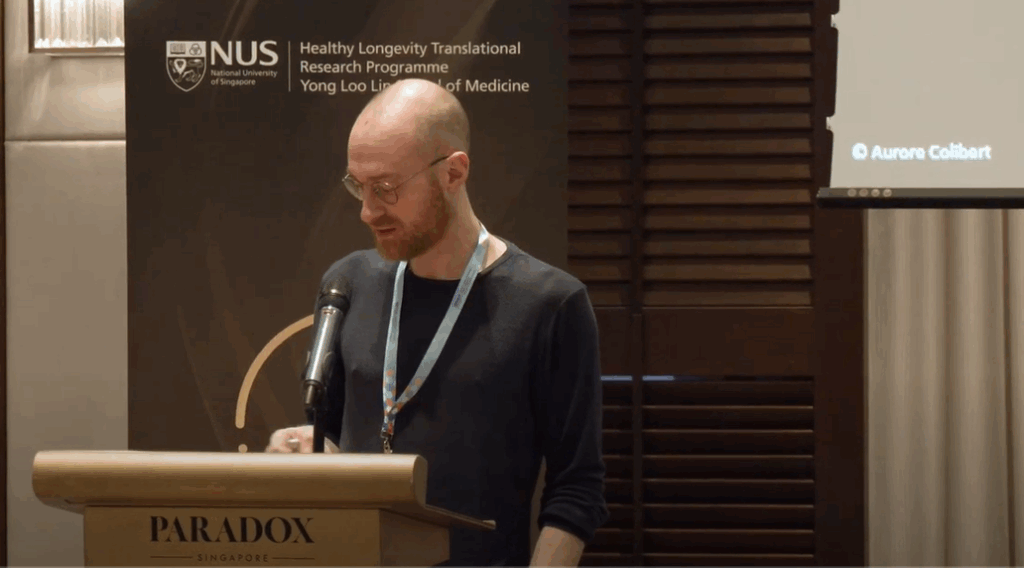
Dr Michael Rera: Ageing as a two-phase process. Reinterpreting hallmarks of ageing and its evolution
- October 13, 2025
- 2:03 pm
Summary
Rethinking Aging: From Continuous Decline to Discontinuous Phases
Based on a 10-year experimental study in Drosophila and mammalian models
Table of Contents
- Introduction
- Traditional View of Aging
- A New Model: The “Smurf” Phenotype
- Two-Phase Aging Model
- Cross-Species Validation
- Extending the Model to Mammals
- Transcriptomic Insights and Genetic Regulation
- Evolutionary Implications
- Human Health and Future Research
- Conclusion
- Key Takeaways
Introduction
Over the last decade, aging research has largely focused on viewing aging as a continuous and progressive decline in physiological functions. However, Dr. Amos Herrera’s research proposes a fundamentally different perspective: aging is not continuous—it occurs in distinct phases, marked by abrupt transitions in physiological and molecular states.
This article summarizes findings from long-term experiments conducted in Drosophila, nematodes, killifish, zebrafish, and mice—highlighting how a simple assay of intestinal permeability led to redefining the biology of aging.
Traditional View of Aging
For most of modern biology, aging has been defined as a time-dependent functional decline of physiological processes leading to increased mortality risk.
Researchers typically studied this by tracking molecular “hallmarks of aging”—such as inflammation, mitochondrial dysfunction, and reduced motility—across an organism’s lifespan. In Drosophila, for instance, older flies display progressive increases in inflammatory markers and a corresponding decline in motor activity.
This conventional view assumes a continuous, linear progression from youth to death. But Herrera’s team challenged that assumption.
A New Model: The “Smurf” Phenotype
Fifteen years ago, Herrera introduced an in vivo intestinal permeability assay using a harmless blue dye. Flies whose guts leaked the dye throughout their bodies turned visibly blue—a phenotype humorously named “Smurf.”
By feeding this dye to aging fly populations, the team discovered:
- Young flies rarely exhibited the Smurf phenotype.
- As populations aged, the proportion of Smurfs increased.
- Flies that turned Smurf invariably died soon after.
Further studies revealed a negative correlation between the rate of Smurf appearance and population life expectancy. In other words, faster accumulation of Smurfs predicted shorter overall lifespan.
Thus, the Smurf phase did not simply reflect chronological age—it indicated biological age and imminent mortality.
Two-Phase Aging Model
In 2015, Herrera’s group proposed a two-phase mathematical model of aging:
- Phase 1: Individuals are non-Smurf, showing stable physiological markers.
- Phase 2: Once they enter the Smurf phase, they are “committed to death.”
This framework redefined aging not as a gradual decline but as a discontinuous transition between stable health and systemic failure.
When examining aging hallmarks such as inflammation and spontaneous mobility:
- Non-Smurfs showed no significant decline with chronological age.
- Smurfs, regardless of age, displayed abrupt deterioration in these parameters.
This shift allowed researchers to view aging physiologically, not merely chronologically.
Cross-Species Validation
Remarkably, the Smurf phenotype appeared across diverse species:
- Multiple Drosophila species
- C. elegans nematodes
- Killifish and zebrafish
In all, the duration of the Smurf phase scaled proportionally with life expectancy. This suggested that the Smurf transition reflects a conserved biological process rather than an artifact of a single species.
Extending the Model to Mammals
The next step was testing whether a comparable two-phase pattern existed in mammals.
In short-lived AKR/J mice (average lifespan: 9 months), researchers longitudinally tracked intestinal permeability, body composition, activity, temperature, and blood glucose.
Findings:
- When data were aligned by birth date, most parameters seemed stable.
- When realigned by death date, nearly all parameters showed biphasic patterns:
- Stable through most of life
- Followed by sharp deterioration in the final weeks
Mice that became “Smurf” exhibited a consistent remaining lifespan of 2–3 weeks, independent of their age at transition—mirroring the 2.4-day pattern in flies.
Thus, even in mammals, aging appears discontinuous, marked by a late-life physiological collapse.
Transcriptomic Insights and Genetic Regulation
To explore the molecular basis of this transition, transcriptomic analyses compared Smurf vs. non-Smurf flies.
Key findings:
- Principal Component Analysis (PCA) cleanly separated Smurfs from non-Smurfs.
- During Phase 1, gene expression noise increased steadily with age—doubling by late life.
- Once noise crossed a threshold, individuals underwent a sudden transcriptional reorganization, involving 3,000+ differentially expressed genes.
Several transcription factors were identified whose suppression delayed Smurf onset and extended lifespan, proving that this transition is genetically controllable.
Network analyses revealed an inflammation-linked module heavily activated in Smurfs, suggesting that loss of immune and homeostatic regulation triggers the shift.
Evolutionary Implications
To test how aging might evolve under selective pressure, Herrera’s team simulated asexual organisms with two key genes:
- XB: Duration of fertility
- XD: Onset of mortality risk
The model showed that organisms evolve toward maximizing fertility duration—dying soon after reproductive capacity ends. Even when constraints were removed, systems stabilized at characteristic life-history trade-offs, reflecting evolutionary tuning between reproduction, maintenance, and death.
Human Health and Future Research
If this two-phase model holds true in humans, it may revolutionize how we assess and intervene in aging. Intestinal permeability—an accessible, quantifiable marker—could serve as an early indicator of systemic decline.
Herrera’s team has now initiated a clinical trial in humans to explore whether similar transitions can be detected, paving the way for diagnostic biomarkers and targeted longevity interventions.
Conclusion
Aging may not be a smooth, gradual fade but rather a two-step process: a long phase of stability followed by a rapid breakdown.
By redefining aging through physiological transitions—using tools as simple as a dye-based assay—we gain a more actionable understanding of the biological clock and its control mechanisms.
This paradigm invites new approaches to delay the critical transition point, potentially extending healthspan before inevitable decline.
Key Takeaways
- Aging is discontinuous: It progresses through two distinct phases rather than a linear decline.
- The Smurf assay (intestinal permeability) serves as a reliable, visible marker of late-life physiological collapse.
- Cross-species conservation: The Smurf phase occurs in flies, nematodes, fish, and mice.
- Molecular basis: Transition involves abrupt transcriptional shifts and inflammation pathways.
- Practical impact: Understanding this transition may lead to biomarkers and interventions for human aging.
Raw Transcript
[00:00] Thank you.
[00:20] met more relevant work to mind than in the past 10 years of meetings I have attended, so I guess it's a good sign for geophysics. So I'm going to present to you today a model that I've been developing in the lab for the past 10 years or so.
[00:40] I won't go too much in the mathematics that we developed on it, but we can definitely discuss it later. So I was. Wait.
[01:00] Okay, no. So let's go back. Okay, so I'm going to start by probably stating the obvious considering the first few presentations, but our definition
[01:20] of phenomenon actually strongly influences the way we study it and for most of the past century the way we define aging is as being continuous process and okay and it's probably mostly based on
[01:40] an intuitive definition of aging that is represented here on this first page of Google Search for Human Aging where you actually see this notion of progressive and continuous changes either here for the quality of the skin, the quantity of hairs on the
[02:00] head of that person, the ability of people to actually move and so on. And the way we actually define it for a work definition is as a time-dependent functional decline of physiological processes that ultimately leads to an increase in activity.
[02:20] in the probability to die. Based on this, we're defined a set of hallmarks of aging that are these molecular and physiological properties that are being affected as time passes. And the way we do study aging in the lab is by looking.
[02:40] at those properties along the life of individuals. Here you have longevity care for a drosophila female population you're used to it so you have this initial survival plateau, the acceleration of mortality and what we do normally is basically take groups of individual
[03:00] at different chronological ages, look at the different all marks, see what changes, and deduce from it what is the impact of time and aging. And if you do so for all these all marks, starting with ear markers of systemic inflammation,
[03:20] You can see that from a young age to an advanced age, you have a progressive and continuous increase of their expression as the individuals get older. You see the same if you look at motor activity. So this here is measured by, sorry, by a negative geotaxic assay.
[03:40] So you place flies in vials, you tap them down, and then you measure in a fixed amount of time what's the distance they can actually go up within the vials. And you see that from young and pretty active individuals you go down to old and a lot less active individuals.
[04:00] But what if instead of having this continuous and progressive vision of aging, you could actually redefine it as a discontinuous process? And so this is based on a simple assay I developed about 15 years ago when I was a postdoc, which is an in vivo measurement of intestinal tract disease.
[04:20] permeability that is relying on the use of a non-toxic and non-absorbed blue food dye. So when you mix that dye to the food of the flies and feed them, normally you have this phenotype here where the blue dye is restricted to the gut of the flies, the whole digestive tract.
[04:40] And I dubbed Smirphenotype for obvious reasons, this phenotype here where the fly becomes completely blue. And what I showed by then is that if you monitor this phenotype as a function of time in your aging population, you see that you start in a relatively young population.
[05:00] before the start of mortality unit with a very low proportion of these SMERF flies. And as the population gets older, you see more and more of these individuals that appear in the population. So we have this assessment of intestinal permeability that shows time
[05:20] dependent increase of the incidence of the phenotype as the population ages. More interestingly, if you look at the rate at which these phenotype increases in populations that are characterized by significantly different life expectancies, you see that you have a negative correlation between the rate of increase
[05:40] and the life expectancy. So here you have two lab population, one of females that live about 30 days, and another one that lives almost twice as long. And what you see is that the shortest lift population is the one in which the rate at which Smurf appear in the population is the highest. So it's not only rate.
[06:00] reflecting advancing age, it's representative of the biological age of your populations. All individuals enter that smear phase prior to death. So this is a longevity curve.
[06:20] that was made from about 1,100 flies, maintained individually on vias with the blue foods starting on day 11, and checked every 24 hours for whether they are smurf, non-smurf, or dead or alive. And what you see is that all line
[06:40] become blue at some point prior to death, the only difference between two individuals that you take is the moment at which those individuals are going to become a smurf and the duration of that smurf phase for these individuals. So based on this, we developed a new model for the use of the smurf.
[07:00] developed a two phase mathematical model that we published in 2015, in which at any time point, instead of having a population made of individuals that we consider as being biological replicates, we can actually identify two sub-populations. One of non-smerfers
[07:20] flies for which we know that the risk of becoming smurf increases with time and a growing proportion of smurfs for which what we know so far is that they are committed to death. So we looked at these hallmarks of aging within this framework and if you start with looking at markers of
[07:40] systemic inflammations. So with a few years of difference, we went from Northern Blood to RTQ-PCR obviously. And what you see is that as non-smare flies become older, you do not see an increase in the expression of these markers of inflammation in the flies.
[08:00] But if you look at what happens in smurfs compared to non-smurfs, whatever the age of individuals, then you see that you have an abrupt increase in the smurfs compared to the age-matched non-smurfs. It's the same if this time you look at spontaneous mobility. So here, the assay is different from the previous one. We just place individual flies in small
[08:20] petri dishes that we record for two hours and project the trajectories in a 2D picture. And you see that in non-smurfs, young or old individuals do not see a difference in their lifespan—sorry, spontaneous motility. But if you look at smurfs versus non-smurfs, then you see a dramatic difference.
[08:40] decrease of the spontaneous motility in smurfs compared to the age-matched non-smurfs. So with this, sorry for the ugly frame, this allows us to switch from Blackbook's view of aging from birth to death to a model where aging is made of at least two consecutive phases.
[09:00] that allows us to switch from a chronological approach of aging towards a physiological one because we have access at the health of individuals and for the hallmarks that I just showed you. Instead of having continuous and progressive changes affecting the whole aging population.
[09:20] we actually have abrupt changes that are affecting a growing proportion of individuals. This is not only happening in the Drosophila melanogaster, we validated the phenotype across the different Drosophila species. They look alike, but they have some millions of years of divergence.
[09:40] it occurs in the nematodes in our abitatie ligands. We checked it in the kilofish and showed it also in the zebrafish. They really become blue. I didn't color them in blue for the presentation. The interesting thing is also that you have a scaling of the duration of the smurf phase between all these organisms.
[10:00] The next question was what is happening in mammals obviously and this was the work of Sailing Council who did a postdoc with me a few years ago and our project consisted in following multiple parameters longitudinally in population of short-lived mice.
[10:20] So here it's a strain of AKRG mice that live approximately nine months and every two to three weeks we measured all these parameters starting with the intestinal permeability in those flies as well as Bodeo- Sorry, can you
[10:40] Yeah, thank you. As well as body weight, body composition, body temperature, glycemia, activity and so on. And the first surprise is that if you look at all these parameters, they are pretty well controlled throughout the life of individuals, which is probably a good sign for them.
[11:00] have glycemia and you see that you have a median value that is pretty well conserved throughout the life of the population. But if instead of aligning all the data on the date of birth of individuals, you start realigning them on the date of death of these individuals, you start having a biphoxic behavior of
[11:20] of this parameter with a first phase that lasts most of the life of individuals where ear glycemia is pretty well controlled and then within the last 40 days also of the life of the individuals, the parameter is going completely off and the only individuals that
[11:40] actually show an increased intestinal permeability three hours per gavage are actually present in that last phase of life. So we checked all the parameters that we measured throughout the life of these mice and we found this biphysic behavior for all of them.
[12:00] You can see here the rectal temperature that drops within the last 25 days of the mice, the glycemia that I showed before, here the body weight, but this is true only in this genetic background. It's not there in the C57 mice.
[12:20] activity, fat composition that we previously also described in mice, in flies, sorry. So with these parameters, we decided to reclassify all our mice as being in phase 1, so non-smurf, or phase 2. And what we could see is that as previously showed in
[12:40] flies. We have a time-dependent increase of the incidence of smurf mice as the population ages. And once mice become smurf, they have an almost constant remaining lifespan of approximately two to three weeks.
[13:00] which was close to 2.4 days in flies. And this independently from the age at which the individual transition into smurfiness. As we already showed in the flies, almost 2.5 million people were in the flies.
[13:20] year all our mice become smurf prior to death. So here you have the life of the mice before becoming smurf, the life duration as soon as they become smurf, and we have a few mice that we missed here probably during the assay.
[13:40] With all this, the next question was what can we actually do within this framework for studying aging? And the first idea was can we try to use it actually to deconvolve the aging transcriptional signal that has been described for the past 20 years or so. And the idea behind that was that
[14:00] By comparing the transcriptome of non-smerf individuals through time, we would be able to identify the gene expression changes that are associated with the time-dependent increasing risk to become a smerf. And on a second aspect, by identifying the gene expression changes occurring in smers compared to non-smers, we would be able to identify the gene expression changes
[14:20] We were able to identify the gene expression changes associated with the high risk of impending death and the whole SMERF package of all Mars. So this was the work of Flaminat Zaneh for a PhD. And the first result that we obtained was with this PCA where we represent the 32 centimeter-in-an-inch surface of the DNA. And that's what we did. And that's what we did. And that's what we did. And that's what we did. And that's what we did. And that's what we did. And that's what we did.
[14:40] samples of whole body RNA that we sequenced. These 32 samples are spread this way. So we have three different time points that correspond to the end of the survival plateau, the T50 of the population, and advanced age. And for each time point, we actually separated Smurfs from these.
[15:00] non-smurfs. And what you can see here is that the principal component that explains almost half of the variance across our samples allows for the almost perfect separation of the smurf samples in blue from the non-smurf samples in red. While the second principal component that is about one third of the magnitude of the first one seems to be
[15:20] segregating samples of non-smurfs as a function of the archaeological age with young samples, midlife samples, and advanced age samples here. With further analysis we could show in a paper that was published last year in Aging Cell that actually during the first phase of
[15:40] of age. The only major changes that we observe in the flies is an increase of the gene expression noise across the replicates with a two-fold increase of the standard deviation per gene as individuals get older. And the idea now is that
[16:00] as this noise increases up to a threshold, then individuals undergo a sharp transition that leads to the 3,000 plus genes that are differentially expressed in Smurfs compared to non-Smurfs and amongst which are found the six transcriptional
[16:20] marks of aging that were published by Frank and collaborators in 2018. Oops. Okay, so based on these differentially expressed genes, we inferred transcriptional factors that were likely to explain their differences in expression.
[16:40] and identified three of them that when inactivated throughout the life of individuals, could actually increase the duration of the initial survival plateau, increase the mean lifespan of the individuals, and this by actually delaying
[17:00] the moment at which individuals do enter the SMERF phase and the rate of increase of these SMERFs. Now what we're doing is trying to infer the gene expression network that is involved in those two phases and especially in the transition. So here you can see
[17:20] WGCNA network, so co-expression network in which we can identify different modules that are affected either by chronological age or by smurfness, as you see here, with this module that is basically an inflammation module.
[17:40] that is strongly activated in the SMERFs. And based on this, we are now inferring the gene interaction networks and could identify about 200 genes that are constituting a core network that seems to allow us to explain the transition.
[18:00] And the interesting thing is that if we look at the incidence of so-called polyangiophilic genes in the subnetwork, we have a 35 percent enrichment where we can only find 10 percent of them if we randomly pick genes in the first network. And in the last two minutes of my talk, I will
[18:20] show you how using this two-phase model actually allows us to reinterpret the selective pressure at stake for the evolution of aging. And so this was a work started almost eight years ago now as a PhD work from Christin Rauger in which we
[18:40] developed a simple model. So this is here an apoloid, an asexual organism that is defined by only two genes, XB that defines the time during which the individual can reproduce and XD which is the time after which the probability to die becomes nonzero.
[19:00] individuals reproduce following this rule. If they reproduce in the gray area a year, they will give rise to a progeny that is of the trait of the parents plus or minus some mutation. But to add some constraints between the two genes, we decided that reproducing between these two
[19:20] values here would be an equivalent of the lensing effect and the progeny would have a strong decrease of their life expectancy. Doing this allowed us to show that such a model was actually evolving towards maximization of the fertility time.
[19:40] with individuals dying as soon as they're done being fertile. And the next question was, what happens if we remove this very strong constraint? And the surprise was even bigger since we showed that system that is actually reproducing and having some amiostasis maintenance.
[20:00] evolve towards this constant value here that is dependent on the intensity of these two genes. Okay I will just stop here because I'm reaching my time so basically the take-home message is we can say that aging can be considered a discontinuous process.
[20:20] this measurement of intestinal permeability gives us access to public way of aging. We have a scaling of the duration of smurfness as a function of the life expectancy at birth of the organism that is considered. Each of the two-phase
[20:40] as distinct mathematical properties that will allow us to ask new question about the underlying phenomenon and finally what could be the implication for human health and I'm happy to share with you that we just started this clinical trial in humans and with this I'm
[21:00] done and thank you for your attention.
[21:20] main functional decline for aging because intestinal tissues are constantly being renewed whereas other tissues are not. So I didn't decide, it decided for itself. So what is your explanation? So what we see from the transcriptomic data is that probably all the
[21:40] tissues are actually becoming leaky. And there is a paper from 2018 by a team in Canada that shows that for example the equivalent of the kidney in the flies also loses its activity. So it's probably
[22:00] probably just one symptom that we measure that is reflecting a loss of integrity of many other tissues. But if you measure various tissue functions, do they always correlate? And is this something that stands out as what is your
[22:20] argument that is the best correlative measure for aging per se. Well so everything we've checked so far as all marks of aging whether transcriptionally at the proteome level or metabolic at the metabolomic level correlates with this intestinal permeability phenotype.
[22:40] So it's just an observation and then now we're building around it. But again, I didn't decide on just looking at the gut permeability and it's an easy phenotype.
[23:00] your data to shed light on whether the transition between these two phases is described let's say by a bifurcation, a subtle note bifurcation, where the the mean feature would be increased maximum in the core variation.
[23:20] just before the transition happens. It does seem to have the data, so the trisectomic data to look into that if you look at it cross-sectionally across the flies. So... What we have so far is...
[23:40] So the finest that we have in terms of time resolution for the transcriptomic is five hours within the transition. So flies that turn, smurf within five hours maximum. And we know that their transcriptome is already correlating with that of a random
[24:00] picked SMERF. So we expect something to happen before, but we do not manage to identify pre-SMERFs yet. So now what we're trying is to actually look at really individual flies in a more longitudinal way to try to
[24:20] identify what comes before the sharp transition. Okay. I hope I answered. Thank you, Dr. Herrera. So I was wondering, you are talking about individual spontaneous occurrence of dysponous. So did you ever check it on the twins, I mean the siblings from the.
[24:40] same parents you know or like the mice that is coming from the same parents you know like how this spontaneous purpose like arises. So the fly populations that we have are highly inbred close to 98.5% and they come from a very limited
[25:00] pairs of parents and yet we still have this noisy entry in the Smurf phase. Okay, so the genetic makeup does not have to do anything like with the transcriptional regulations. Well, so as for the definition of aging, I think
[25:20] There is a genetic part of it, definitely. We find genes that we can use to actually modulate the entry in the smurfness. There is definitely an environmental part. If you put your flies in a very rich medium, you will accelerate.
[25:40] the speed at which Smurfs appear in the population and basically we are looking here at an interaction between both. Thank you Amos. Hi very nice talk very significant to me and I would like to fill in the colleague who asked for its first ones why this is so important.
[26:00] did you choose the permeability of the gut because it's just the starting point of aging. It is very well known in human models that leaky gut is generating systemic inflammation, neuroinflammation, and it is the starting point of.
[26:20] the aging symptoms. So I was very interested in your talk, you can understand. So I don't think that it starts with the guts. Okay? I think that when we look at a large population of humans with the time dependence between the
[26:40] the transition and death, we can definitely observe a correlation that we tend to interpret as being the cause. But at least for the model organisms that we have, if we trigger transient, increased gut permeability, we do not trigger the whole SMERF response, okay? So we have
[27:00] different ways to strongly increase this gut permeability. And in one of the protocol, when flies recover from this increased gut permeability, they live as long as the individuals that didn't get the increased permeability. And another protocol actually leads to lifespan extension.
[27:20] So I don't think that just opening the gut permeability wherever it comes from is sufficient to trigger the whole thing. I think that definitely something happens where there is a dysregulation of the whole genetic network. We have high inflammation that occurs.
[27:40] we see it. We have alterations of genome maintenance processes. We have loss of tissue amiostasis and cellular junctions. All comes altogether, but I don't know which one comes first.
[28:00] Okay, it is reversed. So you can delay the entry in that phase. So far whatever we've done didn't reverse much once you are SMERF. Very interesting. Thank you. Thank you.
[28:20] MUSIC