Summary
The Future of “Gerophysics”: Modeling, Data, and Collaboration to Decode Aging
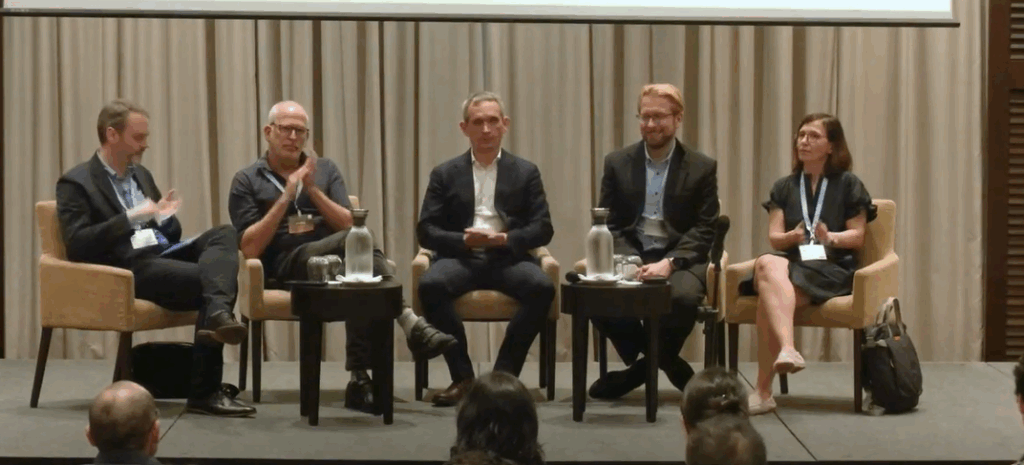
Based on the closing panel and awards session from the inaugural “gerophysics” conference—an interdisciplinary meeting convening physicists, biophysicists, biologists, and clinicians to build theory-driven, computational approaches to aging.
Table of Contents
- Introduction
- 1) Why this meeting was different
- 2) What makes a “good” model of aging?
- 3) Data ↔ Theory: the virtuous cycle
- 4) Do we need new tools?
- 5) Complex systems & network thinking
- 6) Machine learning & generative AI
- 7) Organ-specific vs whole-organism aging
- 8) Building a shared language
- 9) Audience Q&A highlights
- 10) Poster awards & acknowledgments
- Conclusion
- Key Takeaways
Introduction
The panel, “The Future of Gerophysics,” distilled two days of talks that blended physics-style modeling with the messy richness of biology to understand aging. The conversation centered on how simple, falsifiable models can coexist with rich datasets and advanced AI—if we are rigorous about the questions we ask, the abstractions we choose, and the experiments we design to test them.
1) Why this meeting was different
Gerophysics intentionally bridged communities that rarely share a venue: physicists/theorists, experimental biologists, clinicians, and computational scientists. The goal was to bring theory and computation to aging—to move from qualitative lists of hallmarks to quantitative, testable frameworks.
2) What makes a “good” model of aging?
- No single “right” abstraction. Each question demands its own level—what’s “simple” for molecular binding (atom-level detail) differs from what’s “simple” for lifespan dynamics (few parameters).
- Pareto frontier of models. On one axis: comprehensiveness; on the other: understandability. Good models live on the frontier—minimal but sufficient for the task.
- Use-driven simplicity. If the aim is class-level strategy (e.g., which intervention classes can work), favor toy models that isolate essentials.
3) Data ↔ Theory: the virtuous cycle
Physics advances by iterating observation → theory → prediction → new tools → refined theory. For aging:
- Overabundant data ≠ better models. Massive omics can tempt overly complex models that fit noise.
- High-resolution measurement of simple outputs (e.g., the exact shape of survival curves and variance) can be more discriminative than hundreds of features.
- Criterion for a “good theory”: it generates new experiments, not just fits the past.
4) Do we need new tools?
Yes—both experimental and computational:
- Experimentalists need data aligned to model needs (signal quality, sampling regimes, perturbations).
- Modelers need mathematics that compresses noisy biology (renormalization-style thinking) to tractable variables.
- Tool-building is bidirectional: models reveal missing measurements; experiments reshape models.
5) Complex systems & network thinking
- Networks as a bridge across scales. They help conceptualize how microscopic, linear changes (e.g., small damage) can yield macroscopic, nonlinear failures.
- But don’t stop at networks. Biology’s true nature is often circuit-like (direction, strength, function). Networks are coarse approximations on the way to functional circuit models.
- Emergence matters. Variables like “biological age” can behave like mean-field quantities—organ subsystems “vote,” creating an organism-wide state that no single tissue “owns.”
6) Machine learning & generative AI
- Deep learning can compress biology into low-dimensional latent variables that mirror human concepts (e.g., inflammatory tone), but with precision and consistency.
- Power vs understanding. ML excels at doing (prediction, segmentation), but translating that into why (mechanism) remains hard without careful design.
- Generative models (foundations) as Modeling 2.0. Trained on longitudinal health data, they may simulate plausible trajectories, revealing governing constraints. The long-term vision: human–machine co-discovery, where models not only fit but explain and suggest experiments.
7) Organ-specific vs whole-organism aging
- Heterogeneous phenotypes (e.g., dementia vs CVD risk) don’t negate common upstream drivers (e.g., global decline in physiological reserve).
- Expect shared drivers + tissue-specific susceptibilities, modulated by genetics and environment—a hierarchy from global fields to local pathways.
8) Building a shared language
- The bottleneck isn’t only data or math—it’s communication.
- Proposals: pre-conference cross-training sessions, problem-focused working groups, and papers that state assumptions, scales, variables, and tests in jointly readable terms.
9) Audience Q&A highlights
- Water states (coherent vs bulk): an intriguing line of inquiry from biophysics; panel noted they weren’t versed in that literature—an opportunity for future sessions.
- What is “the drift” in aging? Models should name and measure the drift (e.g., damage accumulation, regulatory noise, epigenetic entropy) and show tissue-level predictions.
- Model realism: A “bad-but-clear” model beats no model, as long as we iterate: confront predictions with data and refine.
10) Poster awards & acknowledgments
Poster Prize Highlights
- Shiva Neesha Ravanthiran (NUS): Klotho signaling in mitigating aortic aging
- Trina Tan (NUS): Novel molecule to boost NAD
- Additional winners recognized for work on autophagy regulation in skeletal muscle and related themes.
Thanks & Closing
- Organizers (Max, Jan, Brian), volunteers, sponsors, and media partners were thanked for a flawless event.
- A playful suggestion for next year’s theme: Religion & Longevity—how beliefs and lifespan might co-influence.
Conclusion
The panel converged on a pragmatic philosophy: Start simple and purposeful. Use compact, falsifiable models to guide specific measurements and perturbations. Let data challenge models, not drown them. Combine network/circuit views, low-dimensional statistics, and ML’s compressive power to uncover emergent variables—then translate them back into biologically testable mechanisms. Above all, keep talking across disciplines; progress is fastest when theorists, experimentalists, and clinicians co-design questions and share a language.
Key Takeaways
- Fit the model to the question. The “right” abstraction depends on what you’re trying to predict or control.
- Measure simply, deeply. High-resolution, well-chosen endpoints (e.g., exact survival curve shapes) can outclass sprawling feature sets.
- Networks are a step, not the destination. Aim to graduate from generic graphs to functional circuits and control points.
- ML is powerful but not omniscient. Use it to compress, predict, and generate experiments—then demand mechanistic translation.
- Aging is hierarchical. Expect global drivers plus tissue-specific susceptibilities; model both.
- Collaboration is the catalyst. Shared training, shared terminology, and co-authored, testable theories will move the field from descriptions to interventions.
Raw Transcript
[00:00] session.
[00:20] titled The Future of Geophysics and we have some renowned experts here on the panel who are all physicists or biophysicists and I think the idea of the panel is to try to somewhat synthesize what has been discussed over the last couple of days and also to talk
[00:40] about what happens in the future. And so we have a number of questions that we can go through, but the idea is also for this to be participative. So we'll try to allow some time for the audience to ask some questions. There's a mic in the middle. But before we start, I want to point to the uniqueness of this.
[01:00] gathering in the sense that it brings together people who are not necessarily coming to the same meetings, you know, physicists and biologists, and I think in the aging space this is unique. This is the first geophysics conference, but I think to my knowledge this is the first conference dedicated to bringing
[01:20] bringing together more theory about aging, more computation about aging, and to try to understand how this can shape our understanding of the biology of aging and aging itself. So it's quite unique and I want to thank and congratulate the organizers for
[01:40] enabling this. So thank you very much, Max, Jan and Brian, for this and why don't we give them a round of applause. I also want to thank the other organisers, including at the
[02:00] tight-hipping team and friends and the timers and people who have been supporting this conference. I think they've done a flawless job, so please also give them a round. For that role. Okay, so now that I've secured my invitation to the next edition of this meeting,
[02:20] Why don't we dig into the panel? So the first question I have is about You know, we've seen at this conference multiple models some that were called that were relatively simple that we sometimes refer to as toy models all the way to things like digital twins, which I don't know very well, but seems to be
[02:40] Things that have multiple parameters that rely on large amounts of data. And some of you have said that the simplest models are probably the best, but at the same time we have tons of data, we have tons of information, and we could in theory build complex models to try to understand aging. So what is the
[03:00] right level of obstruction when building a model to understand aging biology and I don't know who wants to take that question. Yeah, Yuri? You can imagine a graph where on the X axis is how comprehensive and complete the model is and the Y axis how understandable it is. Then any phenomenon could be
[03:20] described by whole hierarchy of models. And so like a Pareto front, there are models that are bad because there is a model that's more comprehensible and more understandable. So you're left with the front. See that's why it's important to know how to do models. And each each model is a fiction until you get to the point where you know all the corks.
[03:40] But each model has a different use. So if I want to build a molecule that will bind mTOR, I need to know the hydrogen positions. But if I want to, even those studying biology, if we remember how we're taught glycolysis, let's say, with two arrows in high school and 10 arrows in
[04:00] in the first year of bachelor's school. And if you do a PhD about glycolysis, you know 100 molecules. Each one of those has a different use. You can do a lot with a simple model. So we need experts for each level in this peridot front. And I think physicists and this conference is not just for physicists or anyone I see.
[04:20] likes to be or think in that quadrant of models that have the bare essentials for a given question but no more. If you like that kind of way of thinking, we need that because that's where you can strategize about classes of interventions, about big questions like we heard.
[04:40] And so there's not a right level of abstraction. There's a right level of abstraction for each kind of question. Any other thoughts on this on the panel? Maybe I can say something smart here. So I think one of the interesting
[05:00] The interesting experience in physics was that normally if you think about problems on large scales and obviously aging is a process that has the largest scale in at least individual specimen biology. Normally the largest scale is simply the language that is required to describe phenomena. So in
[05:20] physics language that said that most difficult things renormalize to zero at large scale. That means that even for the most complex phenomena on large scales you don't need too many concepts. Some of them are known like temperature, entropy, I mean we have to respect statistical mechanics. But some of them will emerge as new and specific to aging.
[05:40] So I think one of the goals of the field and the idea of the synthesis with physics is actually to identify this language. So those models at the end of the day when smoke will go away, I think will be still simple and comprehensible. Thank you for that. Okay.
[06:00] So my next question is, you know, drawing some parallel with physics, which is really the inspiration here, we know that there's a cycle between theory and experiments and that you first need to look at observation and try to make sense out of it, you know, formulate some ideas.
[06:20] create some formalism to try to understand what's happening, the phenomenology. But then you also need to test your models and you know, make predictions. These models need to be falsifiable and sometimes, including in physics for instance, there's a need to develop tools that enable testing of these predictions. So if we think about
[06:40] about, for instance, particular accelerators or telescopes, I don't know. So if we think more about biology and medicine and in particular aging research, we are producing more and more data. We are in a data world and we have more and more observations
[07:00] So it seems that we already have a plethora of information to work with. But I want to get a sense from you whether we need to develop new tools, either computational or experimental, to test or even generate new theories. So what are your thoughts on that?
[07:20] I would say that there is a question between, you mentioned now theory and experiments. What is the big data set that I think is fundamentally different if you ask someone who is generating data in the lab and someone who is parsing them through the computer?
[07:40] The thing is that not all the data that's generated is automatically suitable for the model. That's also the problem that we face. And usually you build new tools in order to make this data more usable and better kind of fitting the model that you want to build. And then it's back to this like.
[08:00] how, where is the level of abstraction that you're building, it's of course limiting with the data. But it doesn't mean that if you have all the data in this world that we should build the model that covers all the data because it will be equally complex as the original system and we will not basically move forward. So I think this synergy of that we push each other.
[08:20] other, you know, the experimentalists and theoreticians in a good way that it's really something that is lifting forward. You understand through the model that something is missing and then you have an experimentalist building this platform, building this type of data set, but then this discovers that modern physics are super-
[08:40] powerful, but they are not almighty. Then you have to develop new math, new physics in order to tackle that. So I think an interesting thing that happened in all of our lives, but I noticed this, that when I first came into biology, the producing data was incredibly expensive and slow.
[09:00] So you do, you know, Western blood or you do QPCR and you get some single retort, you do three repeats of something, you get two genes. And so that's necessarily something you do with human, you know, hypothesis-driven work. And then there's this explosion with all the zomics techniques and I think one of the things that often happens is that the models just kill.
[09:20] sharp. So you're trying to build some sort of network-based model that has hundreds of parameters and you're thinking I can now fit this because of all this data. And I think that's a misconception. I actually am most excited about what we call toy models, simple models. But if you create enough data that you can figure out what the real statistical shape of the data is to fit your few
[09:40] parameters really exactly and distinguish two versions of reality then I think that's a much better use than to make a model that you know now is able to incorporate hundreds of features in some mechanistic way that can never be determined and I think lifespan curves are perfect example for this everybody says oh yeah it's a gompertz curve we know what it looks like because it goes up a lot but if you measure it at high
[10:00] decision, you find out in a lot of cases it isn't exactly that shape and the fact that it isn't that shape tells us something important, but you need thousands or tens of thousands of repeat values to get the exact shape and the exact distribution of the noise and that's actually sometimes more informative than having 10,000 features.
[10:20] Once you produce these theories and these models that are good because they're simple, they really abstract the problem. You do need to go back to biology and when you talk to your empiricist friends, they're going to tell you what does that mean in terms of biology. So you need to deabstract the model. I mean, how do you go about it?
[10:40] grow from that to generating predictions that are testable by experimentalists. So for me, definition of a good theory is if it generates a new experiment, not if it's right or wrong. And when I think about math, for me, it's something that if I can't explain in words
[11:00] than I don't understand it. My metaphor is like if I want to paint a fresco here on the ceiling, I need to build a wooden, ugly wooden construction and lie on it. That's the math model. But then I need to take it away and you see the fresco. Okay, so that's my challenge to myself and to my students.
[11:20] Can we explain it in a way that will motivate new experiments? And sometimes it works. Let's switch gears a little bit. And so we had a session today on complex systems, complex dynamical systems.
[11:40] And I personally like these models because they are based on networks. I'm a neuroscientist. I like when information goes through networks and the brain is a great organ to think of as a complex system. But I think people are starting to think about this in the context of aging research. I think we heard today that actually this is really an emerging field.
[12:00] because there isn't a lot of studies out there. And I was wondering if you, I don't know if any of you use these complex systems model, but do you have any thoughts on using these models to understand the aging process specifically? And maybe you want to talk to us.
[12:20] about scales and emergence and some of these concepts. Probably I can reflect a little. So in the book this beginning of infinity by David Deutsch, this guy is reflecting why physics was so powerful. And one of his ideas
[12:40] years was that of course science always goes after the experiment right so this is these issues with data generation and everything else. But then in physics there is this capacity to develop these toy models and these toy models kind of compress all the experimental information to the point that you can actually then test your theories without doing experiments and since
[13:00] experiments are expensive, you can accelerate. So what I think is that we start with from toy models and this network science, I mean everyone has these familiar approaches, this network models, all kinds of microscopic models, specific models. They can actually try to explain different aspects of aging. And if we agree on that, then we can do it.
[13:20] What are the properties of aging that everyone needs to describe in his models? We can quickly select the microscopic models to find those which explain most of the available experimental information most I think these network models are very powerful. They have enormous explanatory power and they also mix well with modern deployment.
[13:40] because they are intrinsically network models. So that's why I believe there is a huge potential. What I think is missing is that we have to decide which is the minimum set of experimental features have to be explained by every model. If we agree on that, we will quickly progress and find the model that is actually working.
[14:00] You have the thoughts on complex networks and how they can be used in aging research. I wonder what you see as a potential node or not have an edge. What should be these represent in terms of aging biology?
[14:20] story about the specific network models, but what I find fascinating is this whole discussion about failure. It's the kind of thing how small amounts of something that changes linearly, and that's the same with the most statistical treatment or maybe looking at the features of a network. You're taking out nodes, you're taking out edges, you're changing weights.
[14:40] And you're getting a specific microscopic behavior because of something that is linear and small on the microscopic level. And you maybe don't need to understand every aspect that's going on. You basically just need to say there is a certain amount of something, be it damage or be it attacks on the nodes or so on and so forth, that then give you a specific microscopic behavior and then ask the question, okay, so what?
[15:00] what is the minimal cost I'm looking for for the behavior that I'm macroscopically seeing. I want to offer maybe a different viewpoint. I think networks are an intermediate step because of our ignorance. The reality is not, like if I take this and say, this is a network of transistors.
[15:20] It's just an approximation because biology is more like a circuit. So it's not that the nodes are hubs and something like that. It's a group of molecules that evolution optimized to work towards specific function. And so the network is kind of like a course approximation. We say we break certain nodes, bonds, etc.
[15:40] of circuits where each node has a meaning, each edge has a direction and a number, and in order to, the way biology regulates function, those top nodes are the ones we should exploit in order to get coherent results rather than... And so, in my opinion, it's...
[16:00] It's hindering us, the network point of view. Okay, I mean for me it seems that we are, it gives you a tool to bridge different scales and get to that perhaps reverse engineering of, you know. I mean it's a step, but we shouldn't get stuck at that step.
[16:20] I like also those network approaches and I often think about it as like a tube map in London or any big city that you have, we are all different, you know, we reach from a point we are born to death to a different trajectory.
[16:40] Network is a way that you could kind of explain this why why we differently reach those points in our life And what this hubs could represent for me for young for you for anyone else in here So it's probably different and I would say like representing the unique human would be kind of a failure
[17:00] There must be a way that kind of shows us this variability in us reaching different trajectories as going through different phases in life. And the network approaches and the complex systems could be a way that you have. You can think about the elevator that it's also extremely robust and could handle a person that it's five kilos and then it can put out.
[17:20] one ton and it will always go with the same speed. So it's a way kind of to handle this type of complexity.
[17:40] It's not something that has traditionally been done in the field. I mean, I think the field has lots of theories, but putting some formalism on the theories is one of the things that this gathering of money is trying to do. But it's also about what I would call the computational aspects and some of the analytical tools that can be developed.
[18:00] to better understand patterns in data. So I see really this sort of space as theoretical and computational aging research in a sense. And so in the context of specifically of applying machine learning techniques to predict aging.
[18:20] trajectories or to identify new biomarkers in high dimensional space. Where do you think we stand at this time and do we have enough data? Do we have the right kind of data? I know we talked a little bit about this but I'd like to hear your thoughts on this. I would take a position here. So we started
[18:40] that with these ideas that at the end the models will be simple and understandable. The problem of course is that the biological data is noisy and complex. And in order to get from this noisy and complex data into this realm of idealistic understandable forms in the forms of understandable
[19:00] differential equations. You have to do lots of mathematical transformations. Physics is called renumerization group. Out of 1,000 students of my university per year, I think less than 50 know how to do that. For some successful examples, Nobel prizes were given. I think doing renumerization group on medical data is
[19:20] beyond analytical capabilities of humanity. So that's where I think the modern machine learning is actually powerful, because if you read papers by Mark Tegmark, for example, from MIT, he says that deep learning is doing precisely that. Deep learning gets your complex data and compresses them to very few variables for which
[19:40] Those are the necessary emergent properties which we are looking for. So I think that deep learning actually empowers us to condense medical data into this comprehensible realm, gives us examples, feeds our intuition, and at the end of the day will help us to get that.
[20:00] so much desired theoretical understanding of aging with immediate practical applications.
[20:20] You could say this is neuroinflammation or sterile inflammation, or you could say this is anabolic or catabolically driven or so on and so forth. Those are sort of broad categories that people understand with lots of experience. And machine learning tools like latent variables might capture some of the same
[20:40] concepts with much more precision so that then you can do statistics on it and have an absolute agreement you know what that means because they're able to do the same thing that people do but they probably have less ego about it maybe a bit more objective in the end. Oh yes you smiling. Remember I mentioned this comprehensively.
[21:00] versus understandable. So science has two faces, understanding and power. You want to do something in the world, we want to heal, want to cure, we want the love of joy of figuring things out. So with machine learning it's great for
[21:20] sought for doing, like if I want to now do image analysis, I don't care how it's identifying the nucleus. I don't care, I just want to identify that nucleus. I want to know where they're buying pocket. But so far, it's very hard to use them to do that.
[21:40] kind of understanding that's the other half of science. So I think we work we need to work together because different people are drawn to these different aspects of power and love I call it, just like in life. And I think in the end machine learning will probably help us build the simple aesthetic models too. Why not?
[22:00] In a way it's about describing the data we have and identifying these patterns which can give you new ideas on how to organize your models. So pushing this question a little bit further, we talked about statistical tools, machine learning. Obviously right now we are witnessing
[22:20] a rise in the power of generative AI and foundation models, which are also part of this trend of creating machine intelligence. So how do you envision these two shaping theoretical frameworks and computational methods in the study of aging specifically?
[22:40] I think in some interesting way, generative, so like Yuri told that you can have descriptive models and explaining models. It's this old discussion by Richard Feynman about Mayan astronomy and European astronomy. So Mayan astronomy could be exceptionally good in predicting specific
[23:00] But European astronomy was efficient in actually explaining them and then became a lot more accurate at the end of the day. So what happens I think is generative AI because what is generative AI? Generative AI is a set of models which cannot generate the data that is not distinguishable from the actual data.
[23:20] So in a way this is the modern way of, I mean, what was called modeling 20 years ago. These days it's now kind of generalized to generative AI. If you train these large foundational models on human health or human and animal health data, casting their own.
[23:40] into the dynamic systems, right, like systems that can generate life histories, for example, of patients or animals. On the inside, these models know the dynamic laws that govern the dynamics of human health. So what I believe is that this is just modeling on steroids with
[24:00] modern machine learning with the tools that, I mean, which as I said, I'd be young at the comprehension and the analytical capabilities of people. I think Generative AI is modeling 2.0. This is exactly where science kind of goes on complex data. This will at the end of the day, I mean, the latin spaces of these models at the end of the day will probably
[24:20] quite the language to explain health.
[24:40] it's more like feeding it with a proper carries proper kind of data asking the proper questions but that's also putting back to when we build the simple toy model we need to do all the things here you could speed up some things but we have to be ready in any way and perhaps there are opportunities to combine these
[25:00] approaches? Yeah I think definitely that's that's one of the the ways this is like so-called hybrid approaches where you in order to understand something you really need to nail down the mechanism and sometimes it's not enough with with simple mechanistic models so you could kind of feed the models with the knowledge that you generally
[25:20] through the generative AI or any of the ML methods and so on. Or you could build some sort of output that resembles AI. Yeah, anything you can imagine. Okay. Just one thing I noticed during this meeting is that the same kind of models and ideas appeared over and over.
[25:40] appeared at very different scales and applied to very different problems. So people start out saying, I want to explain something microscopic and specific, or they start out saying, I want to have the biggest large scale description of a process that produces that sort of pattern. And somehow we all converge on the same sort of insights or on the same sort of models.
[26:00] So one argument is of course that when you take all this complexity and all the details that is in the dataset and you reduce it to the most descriptive small low dimensional description, then maybe actually at that level all that complexity becomes on the fundamental level explainable even to a human. You just describe the dynamics of that latent.
[26:20] or off that eigenvector, whatever you want to call it, and you don't have to worry about all the loadings and all the finer points and all the noise on top because you have a device that does the reduction for you. And then the toy model is the real model, it's the same thing. And I think that's kind of very enlightening and exciting when that happens. I think we've seen it.
[26:40] Thank you. So I'd like to open the mic to the audience. Do you guys have questions? Do you want to grab the microphone over there? I guess that can also go in the room. I don't know what's best. I speak directly to the panel. Okay, good. That's good. I wonder if you...
[27:00] in the future version of this meeting would include water in your comprehensive biophysical and also quantum physics variables. There are, I mean, prestigious
[27:20] scientists studying such as Pollock in Washington or Emilio del Judiche in Naples who have received pregosin awards and stuff like this who have indicated that water in the body is in two different states, the coherent water and the bulk water.
[27:40] and that these different states of water can be modulated and have an incredible role into the physical outcome of the human body. So maybe somebody of you knows about this work?
[28:00] or you consider that it could be interesting. Nobody knows. But as we are constituted majoritarily by water, it is maybe interesting to consider all
[28:20] mathematical and physical work that has been done on water by physicists. So just a suggestion. Thank you. I can answer that. But yeah, you guys don't know about this. Any other questions from the audience?
[28:40] Don't be shy.
[29:00] beyond the drift, what is actually the drift, what is actually happening. So that's one thing. The other thing is the, so you built some model to explain mortality, right? But there could be other things in aging. So we eventually all die that.
[29:20] heart stops, but it could be something else that is drifting and that you end up at. So what I'm trying to get at is tissue-specific aging trajectory. Is it the same mechanism? Is it the same drift that's driving aging in different tissues?
[29:40] Thank you.
[30:00] happen in a different feature space applied to different scales of abstraction and to different kinds of molecules. I think Peter has something else to say about this. So I think that that would be my answer, that you can play with the fundamental process and then you can try to find it at different levels in the organism.
[30:20] So if I, let me try to explain this as a follow. So I think what we need is diffusion of concepts, right? Because we're at Giro's physics conference and one of the, so we've got it from network science today this idea of the mean field. So think about your different aging and different
[30:40] organs as an example of parabeosis within the same system. So all organs are kind of more or less moving the same at the same rate and then one of them gets sick. So what happens to the others? Most probably the others will try to catch up, right? Because that guy is sick and driving them, you know, forward. And the other way around, if for some reason, I don't
[31:00] infection is stopped in that organ and that organ falls back on the normal trajectory. This will push everyone else back. So I think what happens here is what is called the mean field, right? So what is aging? I mean aging is just a total amount of damage in your system. So of course that damage is called damage because it does something bad and that something bad does.
[31:20] some sympat on everything else in your body. So all organs vote for your biological age. So metabolic health for example takes 10 years of life immediately if there is a failure. They vote and the consensus score is the biological age. So that consensus score, the mean field, is the organism-wide variable. And everyone else is just trying
[31:40] to adjust on the way. So this is called emergence, right? I mean, there is no such property like biological age in any particular subsystem, but still it exists. It's like a stock exchange index. It's like your weather, right? It's reported on your TV news. What is that? Is this a property of Boeing? Is this a property of whatever treasury system?
[32:00] It's a property of the economy as a whole. So this is an example of a variable that can be achieved by voting between subsystems and then it's as real as your body temperature, but it doesn't belong to anywhere. Isew and Guillain-Drews were interested in asking questions.
[32:20] I wanted to return to this question of how much AI do we need as opposed to modeling. So I can't help but feel that we don't have, obviously, the laws, we don't know the laws of, the analogues of the Newton's laws of motion in Baoi.
[32:40] We don't have them. And so I'm sort of a little bit skeptical that even generative AI would be able to help us write these laws down. So it may help us point in the right direction, but
[33:00] You still need to make the connections between the variables. So if I may give an analogy, I think if you don't know about the Newton's laws of motion and you want to estimate how far a cannonball will go, you would have to generate data. You would train your model, your machine learning model.
[33:20] able then to make predictions, but you're still possibly overfitting because you can't possibly capture all the complexity in the training data. So at some point you will need to have to use the tools in a way to discover the actual
[33:40] because once you have the laws, you have deep understanding and then you're not dependent on the training data. And let me give you just a concrete example, stimulus. I mean, we understand that we can overexpress for transcription factors to induce.
[34:00] for reprogramming into a puripotent stem cell state. But we don't really understand why exactly, why precisely these four? What is the particular principle that is governing that? And I think we're, I'm sure there's some simple principle that we're just missing.
[34:20] And the question is whether AI you think is going to help us.
[34:40] how does cysteine metabolism work, transulfation pathway, what happens if I do a HOM2, pretty accurate, I check it and stuff. So it's already like my friend, my biology friend knows a lot. And when I dream, I think that just like you know maybe
[35:00] in physics the dream is the unified field equation, that's the object of desire. There may be in biology the ultimate answer will be something like a large language model trained on all of biology, but it's a collaboration between a human being and a person.
[35:20] the computer and that I always wanted to explain it to me, explain it to me, explain to me, and learn what is explanation for a human being, for a physicist, for an engineer, for a doctor, etc. It learns, it's a collaboration, and in the end we'll get to those principles. So for example, it's already known since the 80s that if you
[35:40] If you give the planetary motions to a computer, it will derive Newton's laws, Kepler's laws and then Newton's laws, if you just let it play with algebraic formula. So it's not impossible for a machine to find laws, but it needs the aesthetic that a human being has saying, okay, I need to be a homogeneous in space, time autonomous.
[36:00] explain to you. Okay, if that's the case, that's the experiment I want to see. So I think this mind-machine collaboration is a possible future and the answer in biology will then will be okay, so let's say Morton wants to... by the way, I want to appreciate you for organizing in the ARGD of physics.
[36:20] Max, a physics precursor to this, where we had in a kind of a hall on the side an ex-torture chamber or something. We were meeting there and that was the seat for this meeting. For me it's very moving to be able to
[36:40] talk about math without feeling guilty slash ashamed slash scared. It's great, very, very freeing. So you have some, you want to take the stem cell and learn how to rejuvenate it and you ask
[37:00] this machine how to do it and then you say okay you know how to do it in the kidney now do it in the pancreas and it'll subtract kidney from pancreas and add rejuvenation and a vector kind of thing so it's just a dream it's far away but this collaboration between AI and human understanding I think
[37:20] will be an amazing, enjoyable achievement. So that makes a great segue for my next question. So before we talk to machines and collaborate with them, I think we need to talk to each other. And so unlike in physics, perhaps, I think in biology,
[37:40] There is often a divide between theorists and experimentalists in part because of differences in training and because there isn't necessarily a shared terminology and language. And I think we've seen a little bit of that at this conference. So do you agree with this sentiment and what are the potentials?
[38:00] potential solutions to this.
[38:20] experiences. I think events like this are perfect. If you have three people on the table that are along the spectrum, you can pass on the intuition from one to the other and maybe help translate a little bit. I think that's hugely valuable. People are willing to spend their time. We had that yesterday at dinner where people sit together and even over dinner exchange
[38:40] ideas and drew models and this is among the most fun I've had at a conference. So I think that is the way to go. This is the way to go.
[39:00] of people, the field is broad with various interests. So for instance, in terms of writing papers, how do you, that's something I think people need to think about. Marja, please. Yeah, I fully agree. That is a communication issue is an issue. And really, if you look at the education, we still didn't
[39:20] really move from like hundred years ago where you study math, you study physics, you study chemistry, you were in Moscow, you were across each other. We really need cross interdisciplinary training and how we reach that at what stage. You know, you don't also want to make a hybrid scientist, maybe you want at some stage, but when do you actually introduce people to
[39:40] to start talking and how you do that. And I think this meeting could kind of be one of the spring boards and maybe have like a pre-day or two where you actually have a hands-on training and bring together a medical doctor here, the physicists asked that are kind of, I see myself
[40:00] as a bridge. I try to speak kind of both languages. But like kind of that we are together and that we learn this terminology early on, but also kind of start with solving problems together. So time is up but I think there are still some things to discuss.
[40:20] Sorry, just one other follow-up on the question before also about the organ specific. So 10 to 20% of us will develop dementia, 40% of us will develop cardiovascular disease. So there's some indication that people with Parkinson's disease maybe have a decreased risk of developing
[40:40] in cancer. So it's not always equivalent in aging. The phenotypes that occur with aging are not always equivalent. So that means that there are probably also different processes that are eventually leading to our death. So that's what I was trying to get at that.
[41:00] That in a way these Models are very useful, but maybe also a little simplistic because it could be different things that eventually drive the same end which is death. Short comment on this? Well, the short answer is that a bad model is still better than no model. I think the field has been
[41:20] entertaining aging biology without quantitative theories for sufficient amount of years. The whole this meeting I think is an indication that there is some kind of request to actually try to, well, Vadim is asking me all the time what is aging and I still don't know if I am answering it correctly. So I think there is
[41:40] There is a desire on everybody's behalf to actually settle these things down and actually start progressing at a faster pace. So I would say that of course only the complete microscopic model is the correct model. The only problem is that in large systems they do not exist, they are not computable, they are not writable, they are not presentable, they are not understandable.
[42:00] So I think as Yuri is saying, they should be compromised and I don't believe that for aging they compromise would be on a very sophisticated model. I think we can get a lot in a simple model if we all agree on what is that.
[42:20] like to close the span because we're over time why don't you each go through what's your take-home message you know what you've learned that you think about when you go home and maybe that can help the field going forward like a very quick rapid fire the health of old people is like a mosaic each one is
[42:40] different. That doesn't mean there's an upstream driver that's shared for everyone. Because for everyone, maximal heart rate drops very... So there's things that happen to everyone. But the heterogeneity is genetic and environmental. And also the susceptibilities can be correlated or anti-correlated based on genetic's environment. That answer is your question. It doesn't rule out that there's one
[43:00] or two common drivers. So it's just like a hierarchy.
[43:20] clarifying things that we have that made this useful is that we have the same question we're trying to understand aging. And you can come at the same phenomenon, the different tool sets and you've figured out that you can explain stuff to each other. And that's actually a neat way to start having the problem in common and not the tools. And I think that's useful.
[43:40] kind of view from this is that there is a hope. We are going to do this together. There is like a lot of people working on it and there's a lot of common teams and we are on a good path and it's a lot of optimism. That's great. Well thank you everyone.
[44:00] Thank you.
[44:20] context of how do you see the field evolving. Yeah, it's almost over. We have like 15 more minutes that you have to bear with me, Brian and Jan. But we had a poster session over there, all the nice posters that we had and a lot of people seemed to like them because they almost didn't leave the poster session it seems yesterday.
[44:40] But yeah, we have like a small price for the poster winners and we have like a certificate. And when I call your name now, just come up and walk over here and yeah, it would be great and then we congratulate you. So one of the poster presenters
[45:00] that won the prize is Shiva Neesha Ravan Thiran from NUS who was investigating Kleisenswol mitigating aortic aging. There she is.
[45:20] Thank you.
[45:40] Thank you.
[46:00] Thank you.
[46:20] Unfortunately, she's not here anymore. She had to leave when he goes to the hospital, but we will hand it over to her. Next one is Trina Tan from NUS as well and works on a novel molecule to boost NAD.
[46:40] Thank you.
[47:00] Thank you.
[47:20] Okay, sorry, sorry. So dance to it. Alright kids, one, two, three.
[47:40] in the autophageal division skeletal muscle.
[48:00] Alright, we're going to squeeze the last one. Please come up. Please come up. Alright, we're going to squeeze the last one.
[48:20] Thank you.
[48:40] biologists, but obviously this would not have like been possible with like a lot of other people like our sponsors that like supported us financially and made it possible to get people here to get the prizes to support us. Similar to like our media partners that well had to spread the word.
[49:00] work, wrote articles about it, had to promote an event that a lot of people heard about it and came to this room. Obviously to our speakers that travelled from near and far to give talks and well, engage in the discussions about their science and obviously also to the entire organizing team that like was
[49:20] running around all day at the registration in the back at the financial department, navigating everything to make it as smooth as possible and organizing all the food and everything. So yeah, thank you to all of you that made it possible and yeah, wouldn't be possible otherwise.
[49:40] I just want to have one thing. I think this idea of bringing fields together has been very successful, so hopefully this will continue for geophysics. But I wanted to note that in the last two weeks, by coincidence, I've had two meetings set up for me from theology departments. And so I'm thinking next year, the meetings
[50:00] either going to be the effect of religion on longevity or the effect of longevity on religion. So you can vote for that and decide which one you think is best. Want to say anything? Say goodbye. Bye-bye. Thank you very much.
[50:20] Music